Janaina Mello Landini
visual artist
Brazil
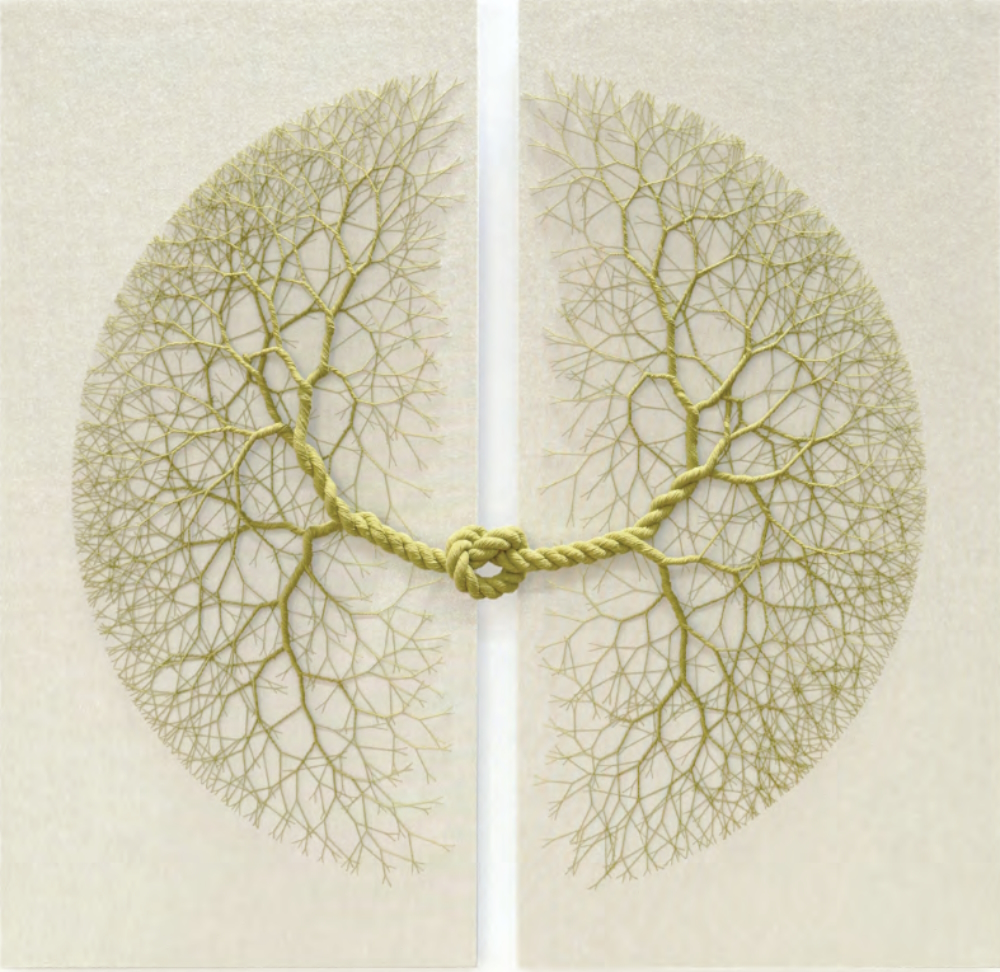
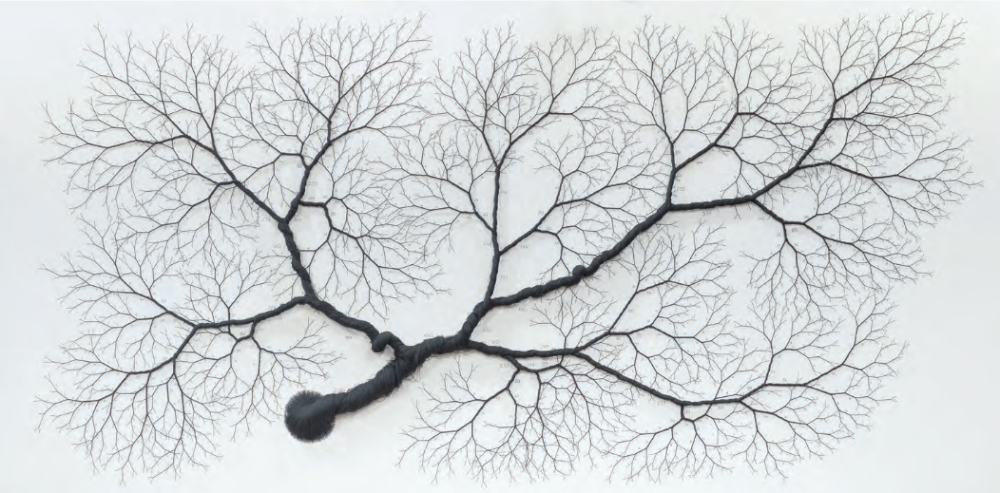
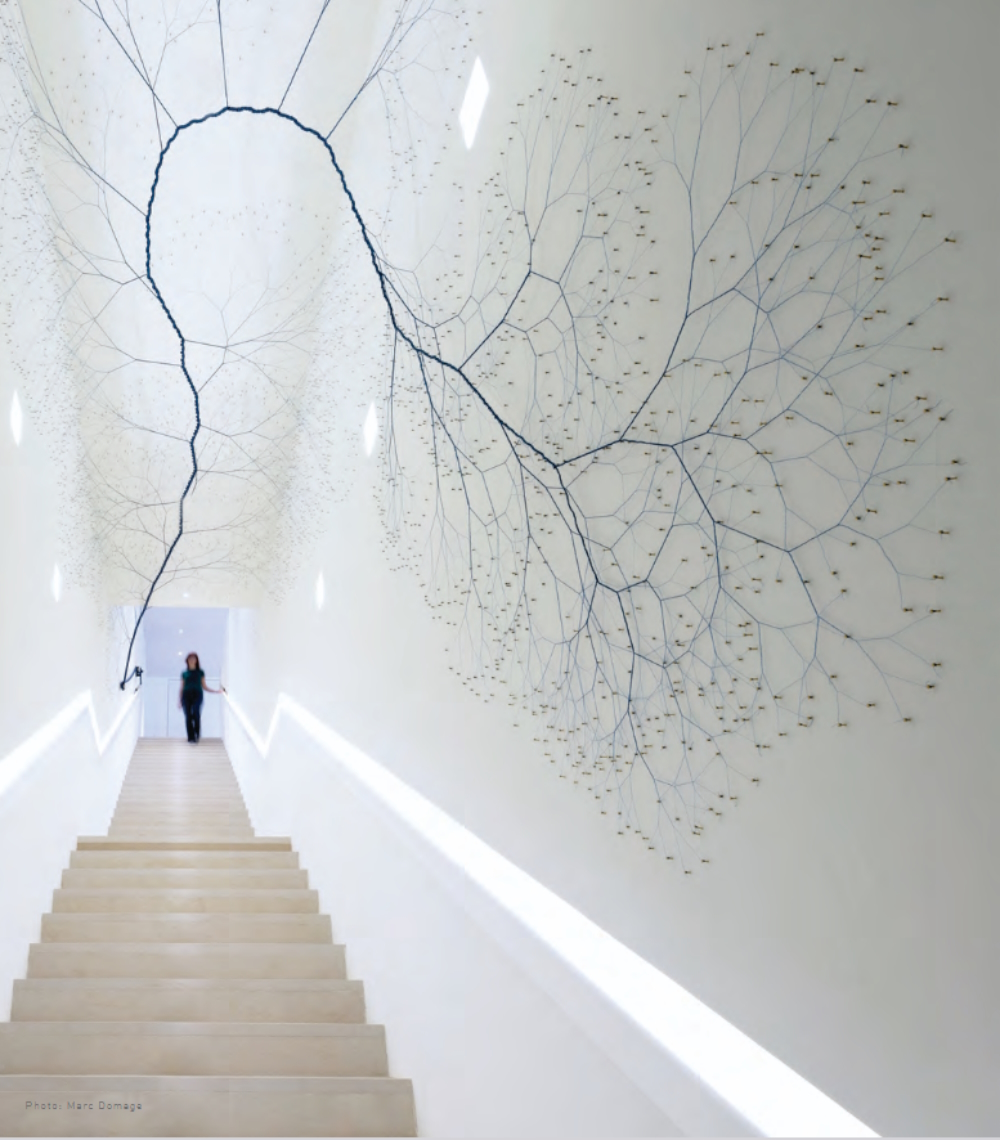
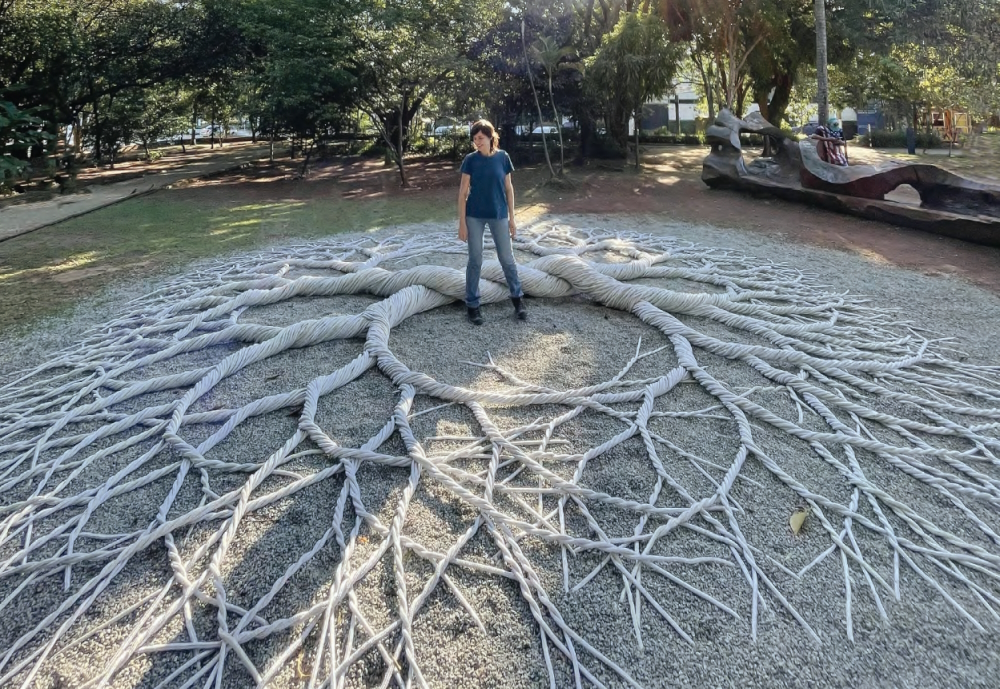
It equals an accolade and secures global publicity if one’s artwork is selected by Peter Gabriel to accompany his musical output. This stroke of luck happened to a Brazilian. The highly renowned English singer, songwriter, musician, and human rights activist (formerly of progrock-group Genesis), whose „Sledgehammer“-video was groundbreaking, choose one of her works to visualize the first tracks „Wolf Moon“/“Been Undone“ from his 2026 album „o\i“. It shows two separate fabric panels spread out in semicircular, highly branched structures. Both extend toward each other, and there is a knot at the connecting center. In a sense, it is the center of everything. „The way she takes the rope and moves it out, unravelling it“, Peter Gabriel praises, „is almost like fractals or tree trunks and looks like the brain in some ways too, so I see a lot of entry points. I am delighted that she’s part of the process.“ The artist in question „works almost exlusively with strings and ropes, which she weaves and knots into wall hangings and expansive webs. Many of them resemble roots, branches, and trees“, states genesis-news.com. „They are also reminiscent of lichen growth or the structures of blood vessels.“ Her unique creations were shown in exhibitions in Brazil, Colombia, Germany, France, Italy, the Netherlands, UK, The US, the United Arab Emirates and in private as well as institutional collections. But prior to this career she had to take professional detours despite an inner urge!
Janaina Mello Landini
visual artist
Brazil
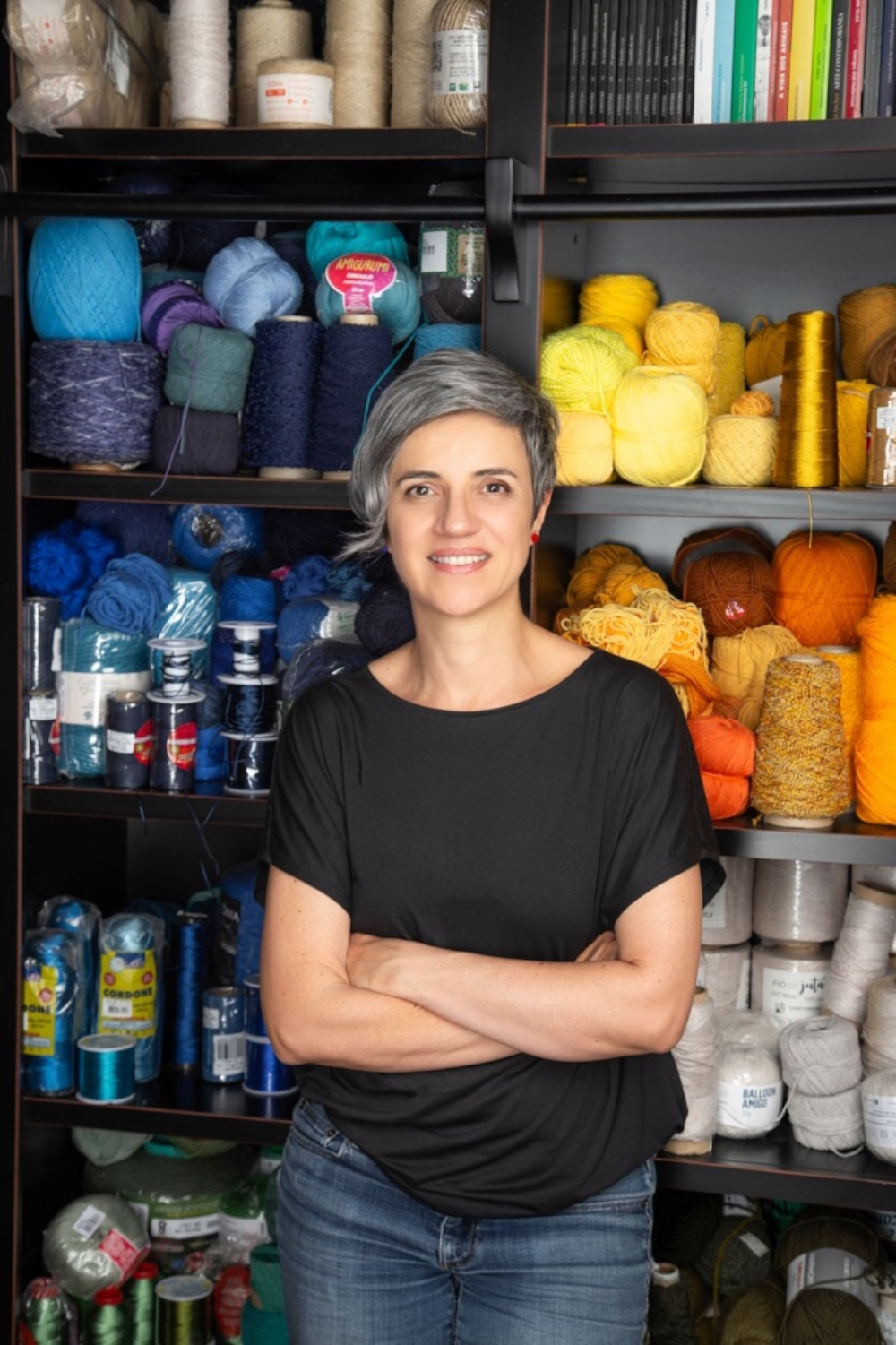
„I wanted to be an artist from the beginning of my existence“, Janiana Mello Landini (* September 20, 1974 in São Gotardo, Minas Gerais, Brazil) told revistatrip.uol.com.br, „but for my family in the countryside, being an artist was not a profession.“ Hence she studied archtecture at The Federal University of Minas Gerais. After her graduation in 1999, further studies in Fine Arts were added there from 2004 to 2007. „In Belo Horizonte, she worked as an architect for ten years, creating scenographies and costumes for theater productions and advertising films between 2003 and 2006. In 2010, Janaina worked as art director for the feature film Blue Desert by Eder Santos (a pioneer of multimedia art in Brazil). She then coordinated the artistic productions at Inhotim Institute and became product designer director for the store of Brazil’s extraordinary museum of contemporary art“ (Wikipedia). „In 2010, Janaina began her experimentation with drawing in four-dimensional space using physical tension, twisting threads, nails, and knots to explore themes of interconnectedness and interdependence. Over canvas, her drawings transform into a blend of painting, sculpture, and embroidery. Cycleweb is the artist's neologism referring to the construction of a schematic, fractal, binary structure that tends towards infinite potential. In 2013, she moved to São Paulo to dedicate herself exclusively to her art.“
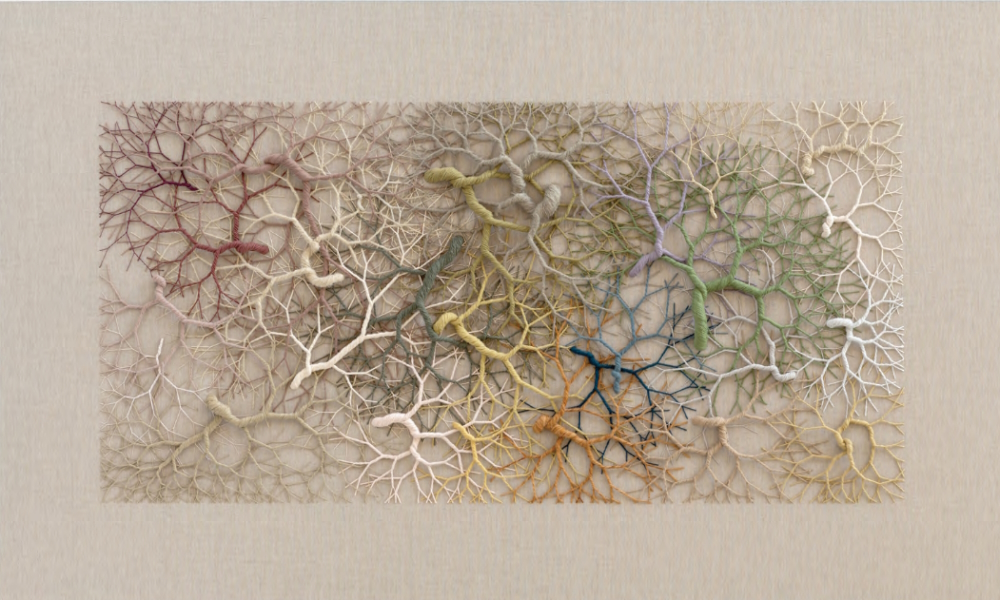
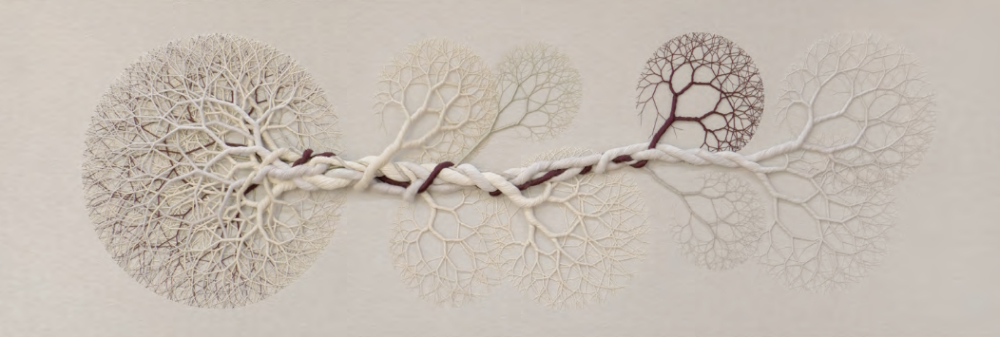
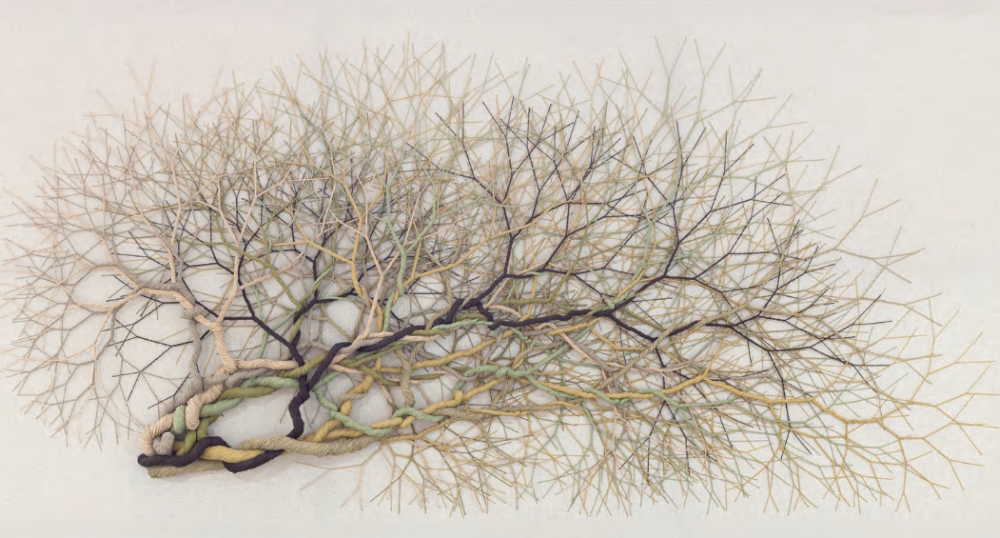
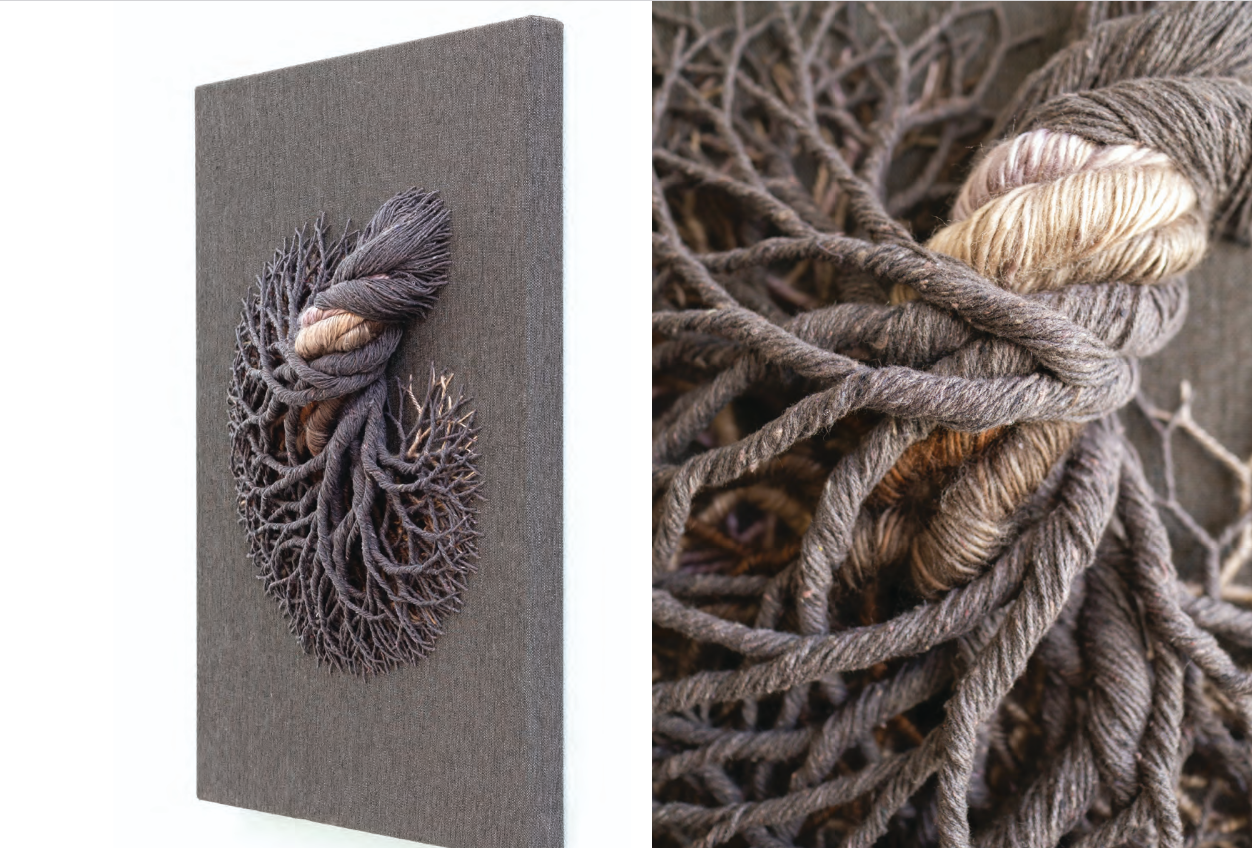
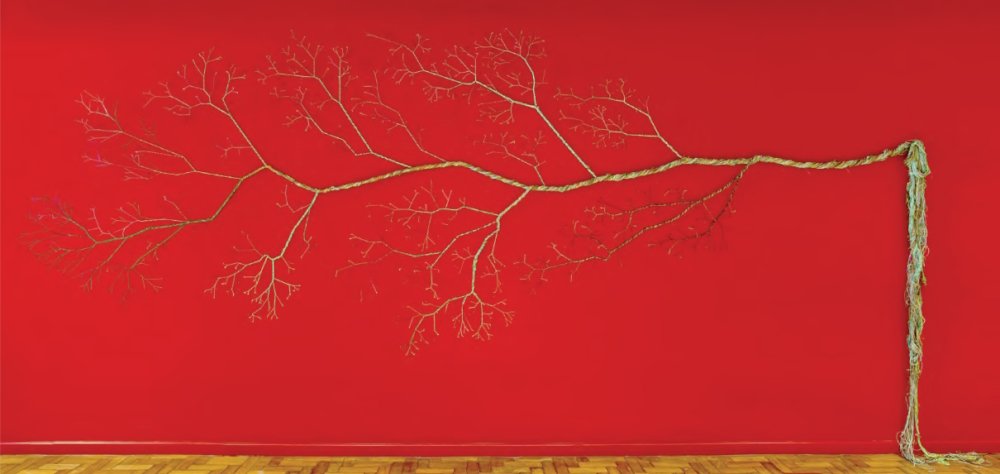
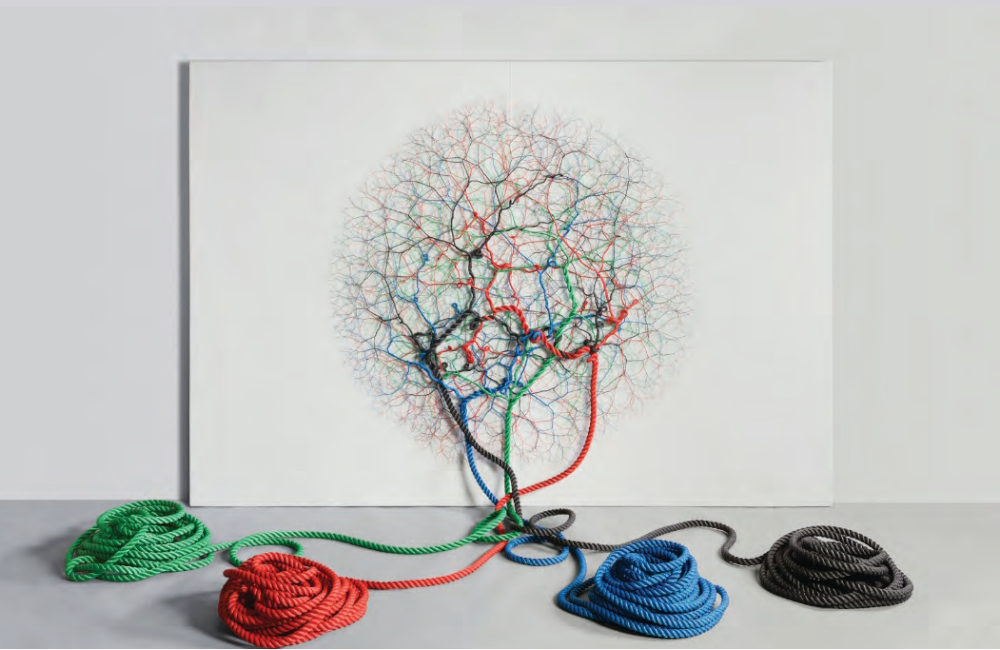
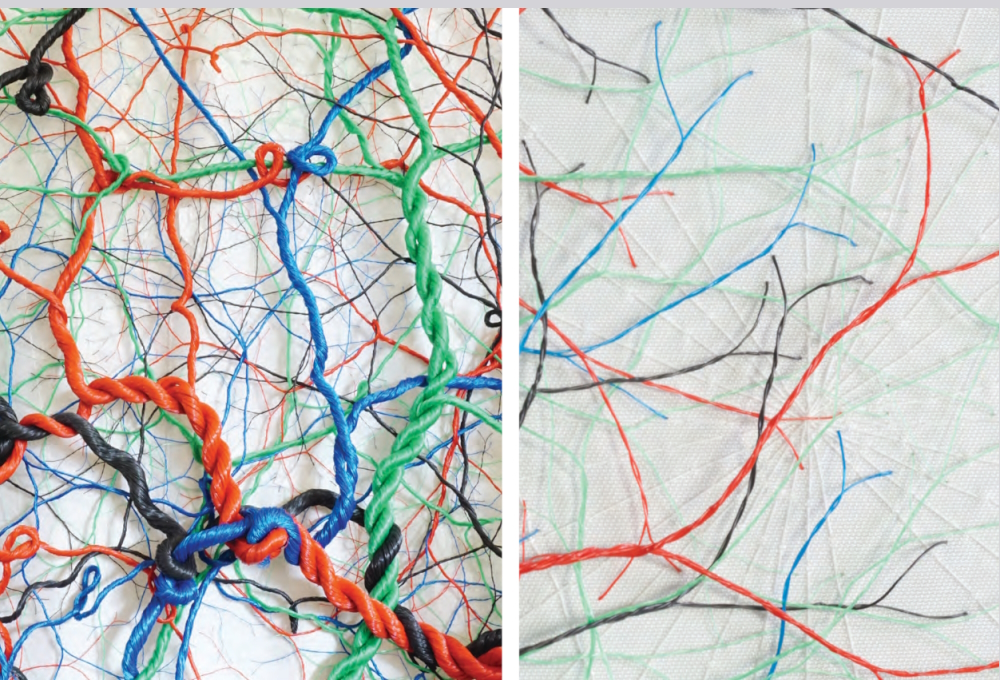
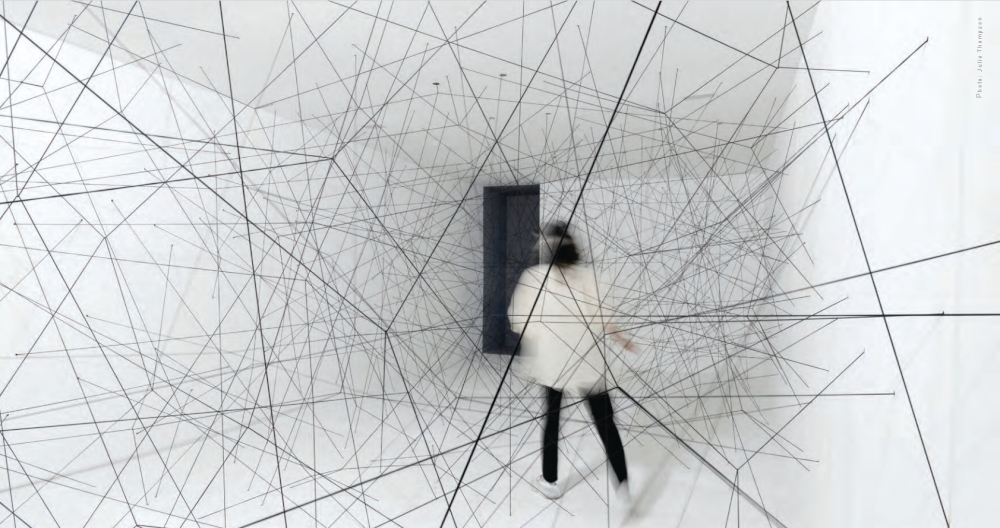
„Janaina Mello Landini unbraids lengths of rope to create fibrous labyrinths that breach canvases’ edges and crawl from floor to ceiling“, notes thisiscolossal.com. „Including both sprawling site-specific installations and smaller pieces confined to a few dozen centimeters, her body of work is broad. All of Landini‘s projects, though, explore tension and space as they spread into arboreal forms or perfectly round networks... Most of her sculptures are composed of a single piece of colorful rope attached to a canvas. By unbraiding certain sections of the twisted cord, the artist creates a complex network of intertwining branches, resulting in web-like patterns. In addition to these wall hangings, she also creates large-scale, site-specific installations that artfully design ordinary spaces with systems of spiderwebs. The artist’s main idea is to create a physical experience of tension, depicting imaginary networks, which define spaces and retell stories.“
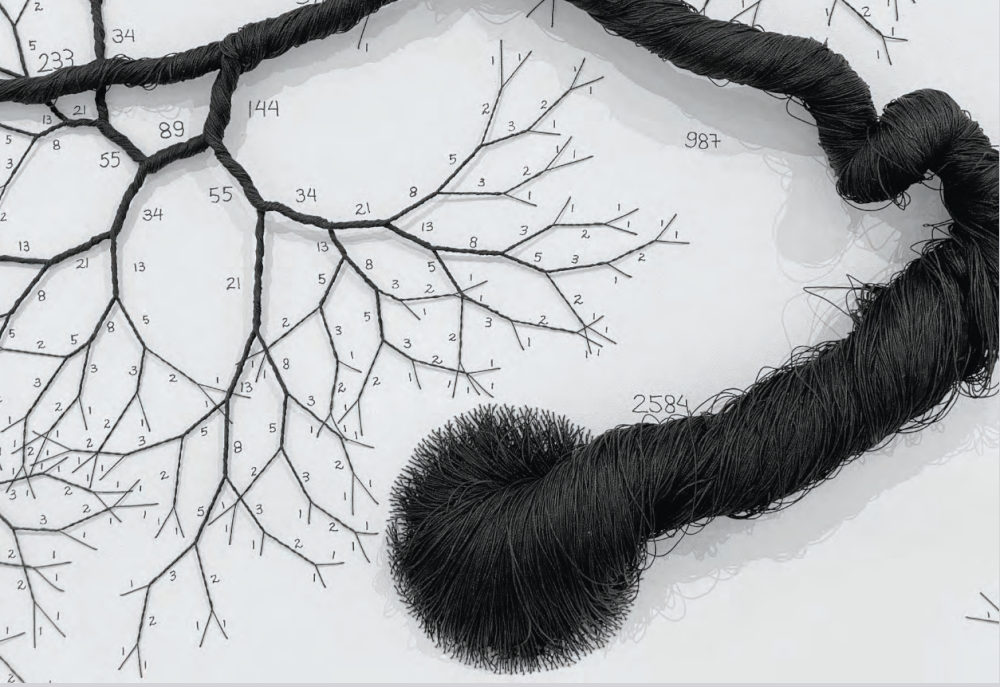
On her website Mrs. Landini describes the basic points of her artistic output: „It encompasses the knowledge of architecture, physics and mathematics and observations about time and multiplicity, to weave her worldview.“ The real influential condiments were broken down in detail on revistatrip.uol.com.br: „Everything there is measured down to the millimetre, based on studies of fluid dynamics, geometric progression, Fibonacci sequences and everything else that helps to design the relationship between a 3D work and physical space. Leonardo Da Vinci's calculations served as inspiration and represent the patterns seen in the formation of veins, arteries, rivers, roots, among other forms of nature... Anatomy studies also fuel the creative process, especially the 1831 book Atlas of Human Anatomy and Surgery, illustrated with lithographs by French artist Nicolas Henri Jacob... Beyond mathematics, some can approach the idea of rhizomatic thinking, as proposed by French philosopher Gilles Deleuze. The book in which he discusses this concept is A Thousand Plateaus, published in the 1980s, together with Félix Guattari.“
Asked for the reason she uses rope, Janaina Mello Landini replies: „It’s an object of the everyday world, only transformed by the action of undo and redo—unroll, divide and twist—and the time spent in this process is imprinted on the organic body.” Speaking of the creation process: it often takes month or even years to complete!
In this time of the digital age her handmade art brings up an important aspect: it's all a matter of perspective! Taking individual and changing ones broadens the vision to other possible interpretations in a web of multitude references.
Janaina Mello Landini lives and works in São Paulo, Brazil.
Interview February 2026
Nature inspires art: changing perspectives for broading other possible interpretations in a web of multitude references
INTUITION/IMAGINATION
?: How does intuition present itself to you – in form of a suspicious impression, a spontaneous visualisation or whatever - maybe in dreams?
Intuition appears more as a bodily state than as a clear image. It is a sensation of tension or alignment: something “pulls” or “resists.” Sometimes it comes as a sudden visualization — a structure, a flow, a knot — but almost never fully formed. Dreams do exist, but they function more as sedimentation than as a direct origin.
?: Will any ideas be written down immediately and archived?
Yes, almost always. Even embryonic ideas are recorded — not to be obeyed, but so they are not lost. They form a living archive that can remain dormant for years until it finds the right context.
?: How do you come up with good or extraordinary ideas?
More through listening than active searching. They emerge from accumulation: reading, observation, conversations, science, philosophy, materials. When I am able to read the world through the particular language of my threads, and something connects those two fields in an inevitable way, I know there is potential there.
?: Do you feel that new creative ideas come as a whole or do you get like a little seed of inspiration that evolves into something else and has to be realized by endless trials and errors in form of constant developments until the final result?
Almost always as a structural seed — a simple rule, a mathematical principle, a minimal gesture — which then demands numerous tests, adjustments, and errors before taking form. I often say that my favorite work is always the next one, the one I have not yet made. Because it still exists in my mind, it is always perfect. The process is as important as the result; it is always a dialogue between my will and the will of the structure that is taking shape and teaching me as well.
?: What if there is a deadline, but no intuition? Does the first fuel the latter maybe?
A deadline can function like a gravitational field. Intuition does not always come first; sometimes it appears in response to the concrete need to act. But there are always elements orbiting the mind as potential. Intuition is more connected to the path a project should follow — which of the many possible answers to the same problem I will choose to materialize.
INSPIRATION
?: What inspires you and how do you stimulate this special form of imaginativeness?
Nature, living systems, science, mathematics, philosophy, but also everyday gestures, manual labor, repetition, silence. I stimulate imagination by creating conditions for it: time, attention, listening, the body in action.
?: How do you filter between ideas that are worthwhile pursuing and bad ones that you just let go of?
That is a great question. There is a degree of inner necessity in an idea. Good ideas insist; they cross contexts and survive time. The so-called “bad” ideas are born alone and end up in a drawer. I have learned they are not bad; they are simply outside the context of the creative process at that moment. They arrived too early and seem not to make sense. Over the years, the work evolves and fills the void that once existed between ideas. When you encounter that old, once-rejected idea again, you realize it does make sense — just not at that time.
?: Does an idea need to appeal to you primarily or is its commercial potential an essential factor?
It must convince me conceptually and ethically first. The commercial aspect is only considered if something in the idea becomes incompatible with that requirement. Many institutional installations I have built were extremely important in my career but were meant to be dismantled after the exhibition. They were not created to be commercialized. For me, that is wonderful.
?: Do you revisit old ideas or check what colleagues or competitors are up to at times?
Returning to old ideas is essential — they mature alongside me. This does not usually happen intentionally; interestingly, elements that were previously explored reappear as part of a repertoire I now have available to say what I want to say. I admire other artists for the quality of their gaze, not as comparison, but as dialogue.
CREATIVITY
?: What time or environment best suits your creative work process — for example, a time and place of tranquility or of pressure?
A quiet environment, with long stretches of uninterrupted time. The work requires immersion.
?: What’s better in the realization process — for example, speed and forcing creativity by grasping the magic of the moment or a slow, ripening process for implementation and elaboration?
The conception can be fast; the realization is slow. Forcing the initial gesture can work, but refinement demands time.
?: How important are self-doubt and criticism by others during such a process?
Doubt is structural — it keeps the work alive. External criticism is welcome when it comes from genuine listening, not from projected expectations.
?: Is it better to be creative on your own, to trust only your own instincts, or to work in a team?
The work is authored by me, and the result is a drawing made by the gesture of my hand. I control the entire process. Yet realization often requires collaboration. I need many hands to finish the repetitive work of threading the needle, passing it behind the canvas, and tying the final knot. It is repetitive, but it creates a meditative atmosphere and allows for meaningful conversations with hands in motion.
?: In case of a creative block or, worse, a real failure, how do you get out of such a hole?
By changing scale: working with my hands, studying, walking, learning or teaching. Sometimes the block is simply an excess of control.
?: Should a creative person always stay true to him- or herself, including taking risks and going against the flow, or must the person, for reasons of commercial survival, make concessions to the demands of the market, the wishes of clients and the audience’s expectations?
An artist works to organize what suffocates them. An artist who does not produce suffers deeply. The artist knows what they are made of and must follow that substance. The entire path of constructing a work must be honest, deep, and a reflection of the thinking built throughout the process. I am often startled when someone believes they can commission a work already knowing exactly how it should look, as if I were merely the instrument of their will. I do not have that openness. My work carries a whole line of thought behind it; if it does not make sense, I simply refuse the offer.
?: How are innovation and improvement possible if you’ve established a distinctive style? Is it good to be ahead of your time, even if you hazard not being understood?
By deepening, not repeating. A true style is not a formula; it is an open field. There is always more to say. Even if not immediately understood, the process itself is the guide.
?: When does the time come to end the creative process, to be content and set the final result free? Or is it always a work-in-progress, with an endless possibility of improvement?
In my case, it is simple: when there are no more threads to weave into the canvas. I see my work as a whole; the composition follows its parameters even when I experiment. Each work is unique, so I have no difficulty finishing them because there will always be another to explore the doubt generated by experience.
?: How does artificial intelligence change human creativity? And do you? Would will you use it at all?
I remember when Photoshop emerged — the reaction was similar. What we do with a tool does not replace what we think as artists. AI expands tools and accelerates processes. It can be used as an instrument to generate worlds. As creatives, we will certainly learn to benefit from this new modus operandi. I hope much will change, but never as a substitution for lived, sensitive, bodily experience, let’s see.
SUCCESS
“Success is the ability to go from one failure to another with no loss of enthusiasm.” Do you agree with Winston Churchill‘s quote?
Yes. Persistence with enthusiasm is more decisive than any isolated victory. Life is always the possibility of having a new project.
?: Should or can you resist the temptation to recycle a ‘formula’ you're successful with?
When I was a teenager, I was a competitive swimmer. That is something that shaped my ego. There is never any guarantee of anything. The effort of successive small steps is what allows you to evolve. It is always risky, but necessary. When one or another achievement happens, for me they are medals of the process. But anyone who has been an athlete knows where to place the weight of a conquest: in the desire to do better next time. The idea of a “formula for success” is an illusion.
?: Is it desirable to create an ultimate or timeless work? Doesn’t “top of the ladder” bring up the question, “What’s next?” — that is, isn’t such a personal peak “the end”?
Recently I read a book that said if we can evolve, it means we will never be finished. Applying that to your question: perhaps not “timeless,” but precisely situated. The danger of reaching “the top” is confusing recognition with completion. What comes next is always the real question.
MY FAVOURITE WORK:
Ciclotrama is a term I created to suggest a cyclical weave that tends toward infinity, inspired by the logic of infinitesimal calculus. Studying calculus led me to experience infinity not as an abstract idea, but as something that is always greater than any version of infinity we can imagine. At the same time, I began to question its opposite: what is the one, the singular, the individual? In trying to listen to what was quietly insisting inside me, I encountered sewing threads while altering clothes. As I unraveled them, it felt as though they carried their own histories, lives that existed before my gesture. That encounter offered a language through which I could explore the tension between what makes the one and what forms a whole. From there, Ciclotrama grew organically, expanding through different series, each deepening this reflection into ever more complex structures.
Ciclotrama synthesizes everything: structure and intuition, mathematics and body, repetition and variation, individual and system. It is a process-work, open, never fully closed — like thought itself.