Michael Murphy
sculptor / pioneer of Perceptual Art / inventor
US
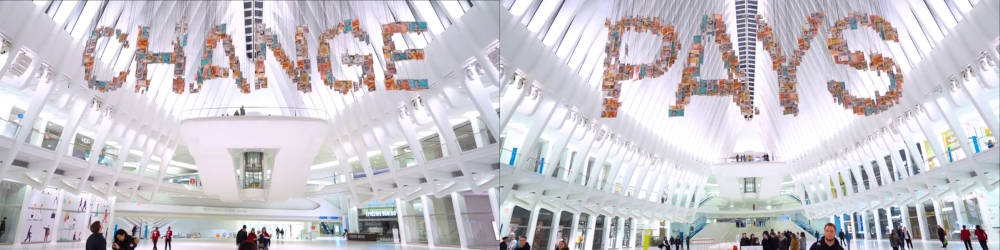
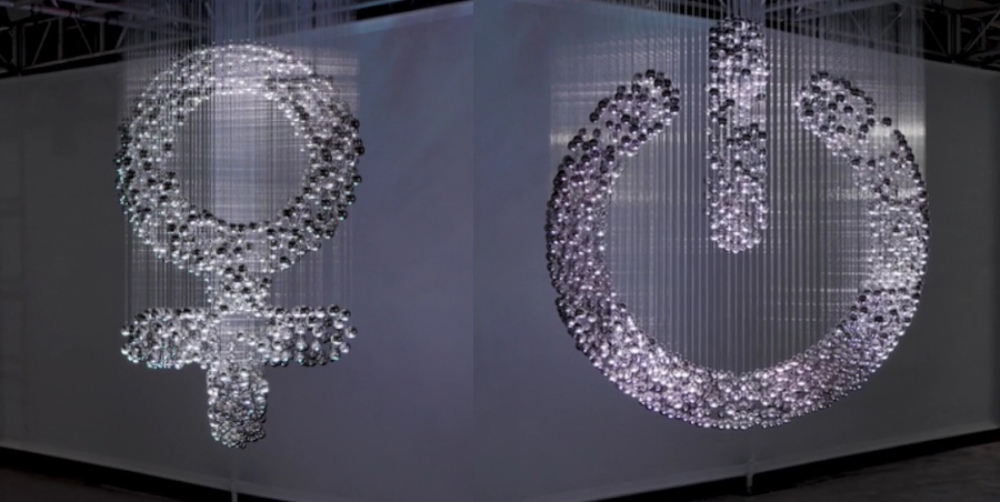
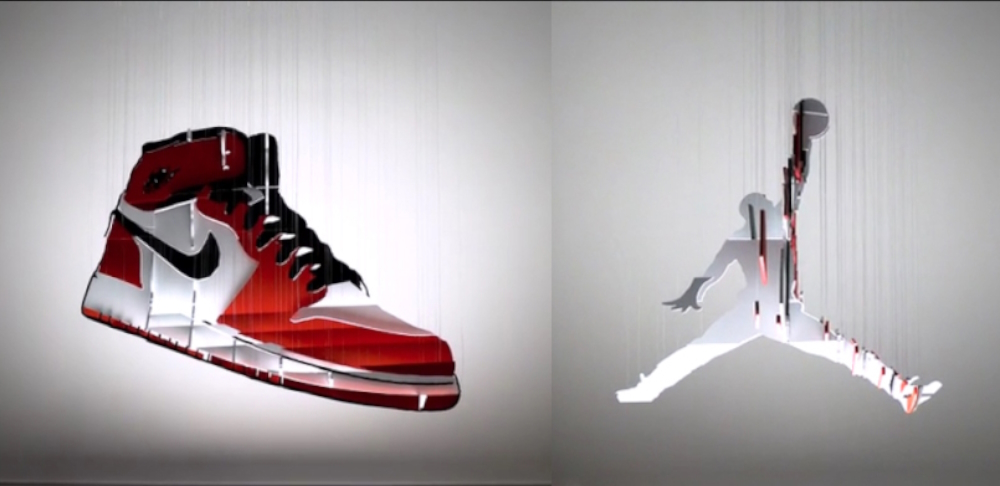
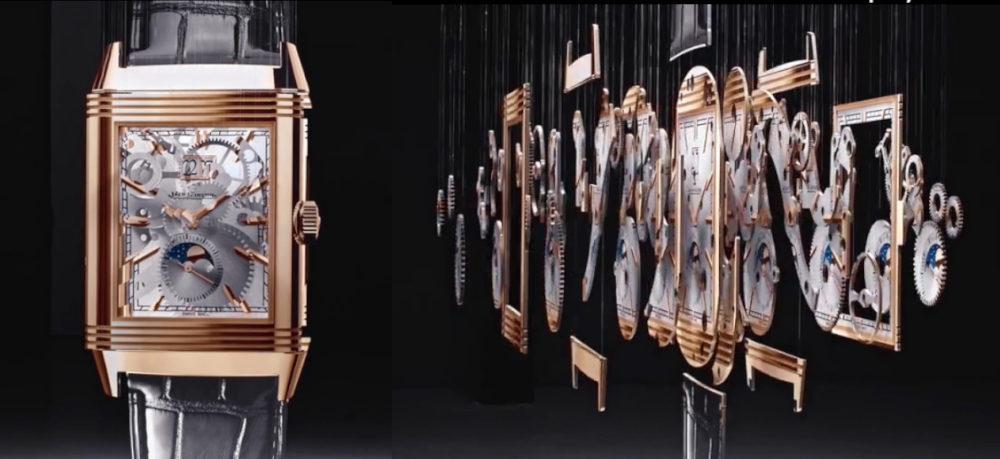
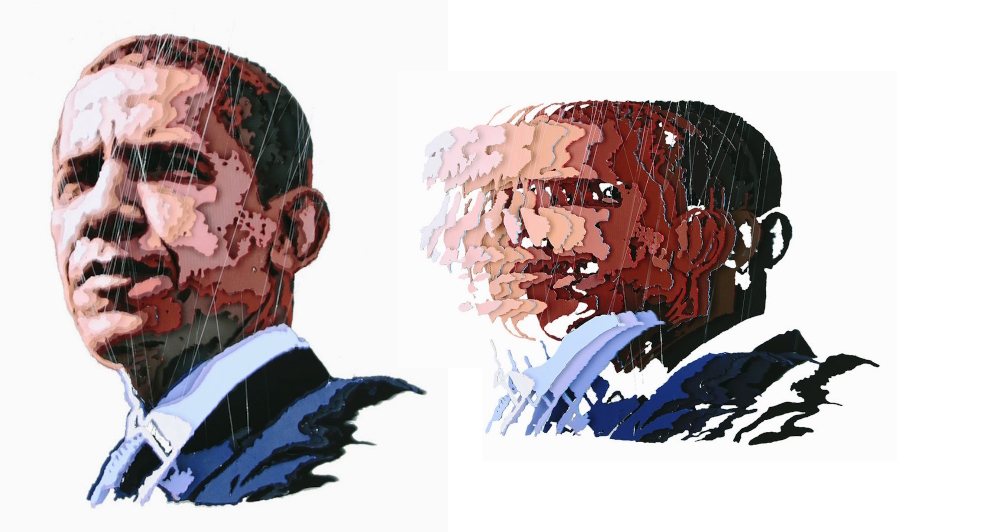
His creation of a portrait of U.S. presidential candidate Barack Obma in 2007 inspired thousands of artists to contribute to the “Art for Obama“ movement. This American sculptor uses unconventional, often recycled materials, arranging them into site-specific installations and anamorphic sculptures, “combining two-dimensional images with three-dimensional forms“ (dailymail.com). In doing so the pioneer of Perceptual Art “seeks to break the boundaries of what is typically thought of as art“ (wbontrag.wordpress.com) and “definitively describes the new era of sculpture art“ (welum.com). His “suspended narrative mobiles“ (self description), often activist art as well, have been highlighted in TIME magazine (including a cover commission!) among many others. Global brands like Google, Jaeger-LeCoultre (luxury watches), Lexus, LG, NBCUniversal, Nike, Toyota and many more make up the artist’s client list. The outstanding talent of “one of the most celebrated and sought-after artists in the world“ (insidehook.com) found its expression as early as childhood.
Michael Murphy
sculptor / pioneer of Perceptual Art / inventor
US
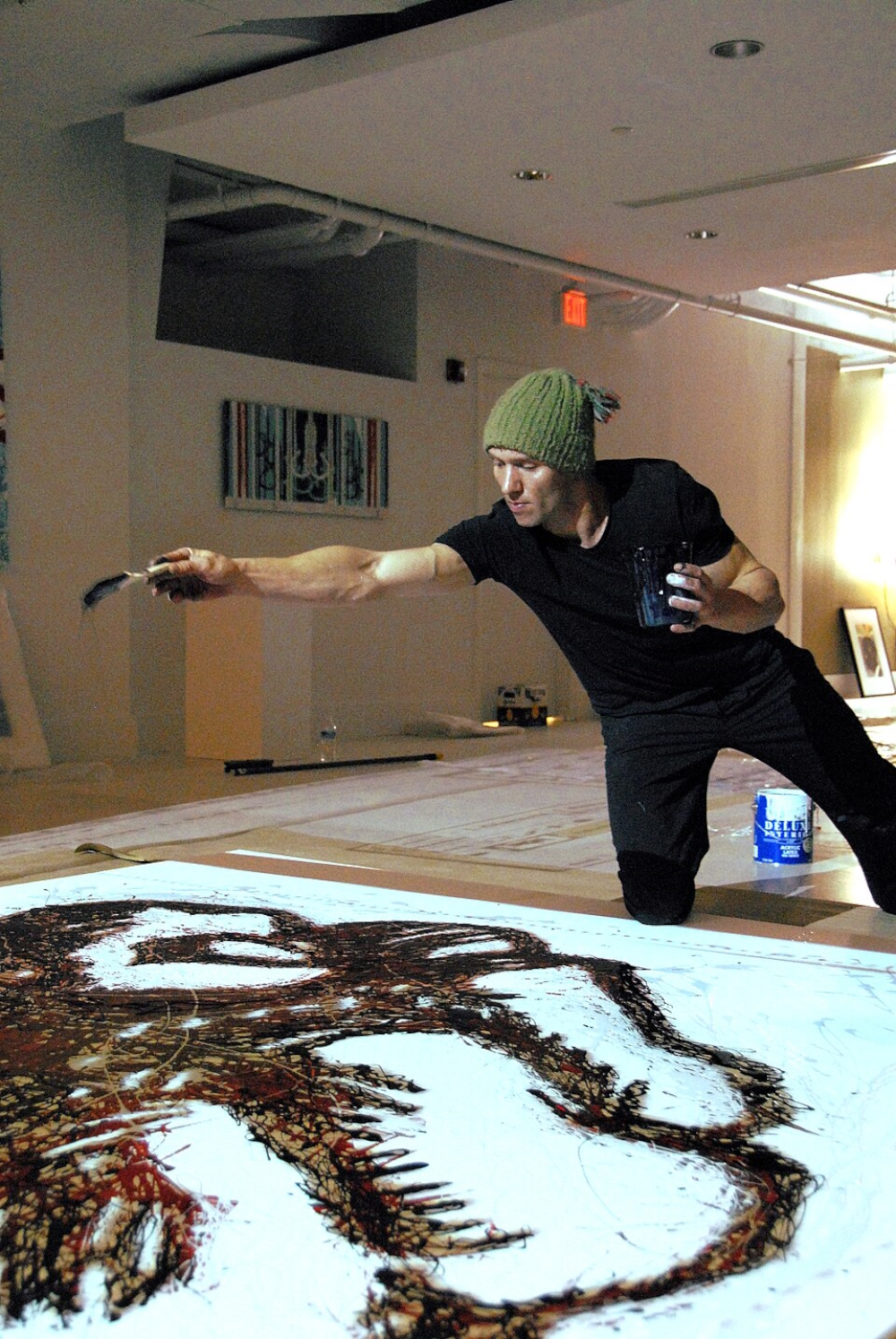
“Your son is going to be an artist.“ This is what Charlene Galose, art teacher of Michael Murphy (born March 22, 1975, in Youngstown, Ohio) in fifth grade at Glenwood Middle School, told the boy’s mother. “When you are a teacher and have hundreds and hundreds of students go by you, every so often you have a student who will show a particular talent“ (The Vindicator). Now she’s proud that her prediction came true.
After graduating from Youngstown’s Boardman High School in 1993 Michael Murphy “earned his Bachelor of Fine Arts and sculpture training from Kent State University in 2000. He then earned his Master of Fine Arts in sculpture, art and technology from the School of the Art Institute of Chicago while focusing on sound art, installation and metal casting. In 2000 MM began his teaching career at one of the best art schools in the U.S. and then at various universities for twelve years. He retired in 2013 to focus exclusively on his art“ (Wikipedia), having started working for himself at the turn of the century.
Mr. Murphy created his very first multi-directional illusion sculpture in the 1990s. “I was learning how to model clay and cast cement“, he says on insidehook.com. “So I had modeled in clay, a sculpture that was representational of a woman from one side and a man from the other. It was pretty bad, really.“ Those early days are long gone; he has mastered his craft through years of experimentation. “I didn’t decide that I was going to make Perceptual Art. I arrived at it because the emphasis of my work is largely on the viewer’s perception.“
When this virtuoso creates a work of art these days, the idea is first visualized as a flat graphic and then turned into 3D on the computer, followed by spreadsheets and CAD drawings. Finally on the basis of 30 or 40 different models, the correct solution is figured out. This process can take between a week and a year. The objects measure between three and 22 feet in size.
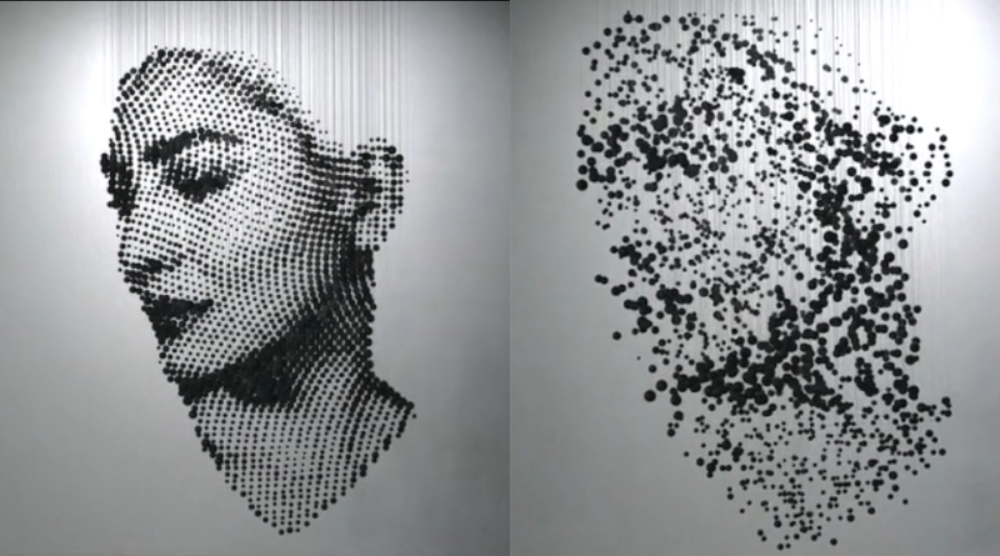
“His work at first looks like an unorganized composition of material,“ welum.com writes, “but when viewed from a proper angle, becomes a highly organized suspended three-dimensional graphic image.“ Different as they may be, all of Michael Murphy’s personal works are linked by the deeper meaning of this statement from collater.al: “One of my motivations is to sift through everything around us and figure out what’s important. Every time a piece inspires someone to think more deeply... I see that as a win.“
· Electoral Divide is a portrait of Barack Obama, TIME magazine’s Person of the Year 2012. The piece consists of 66 hand-cut and painted cardboard plates suspended on white braided fibers. Viewed straight on, it shows a graphic portrait. Walking around it reveals its distortion as the red and blue edges of the plates indicate the electoral divides. From the side it suggests growth, progress, movement and the partisan divide.
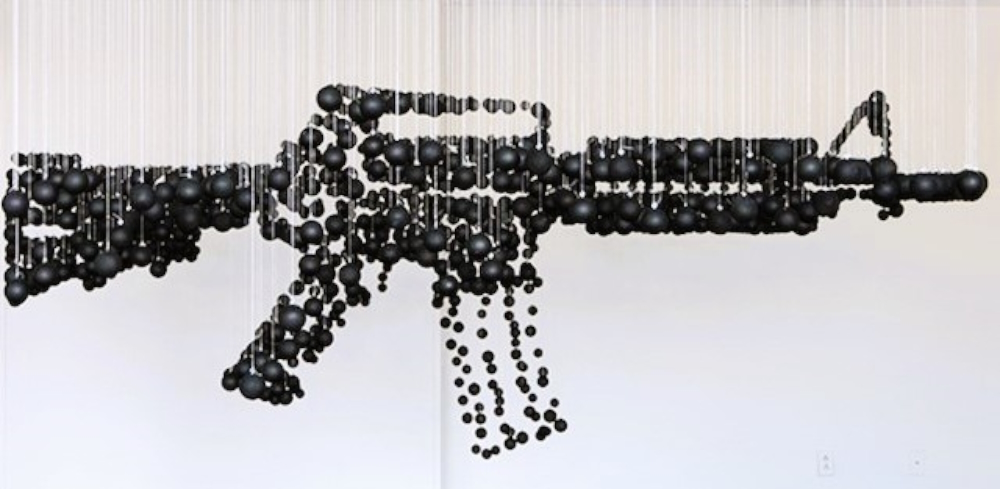
· Damage “consists of 1,200 ping pong balls painted black and suspended from the ceiling. When viewed from the correct angle the balls coalesce into an expanded graphic of an assault rifle. Historically, secret societies have used little black balls to indicate a „no“ vote“ (Wikipedia). “It reminds me“, Michael Murphy states on mymodernmet.com, “of the lives taken by gun violence.“
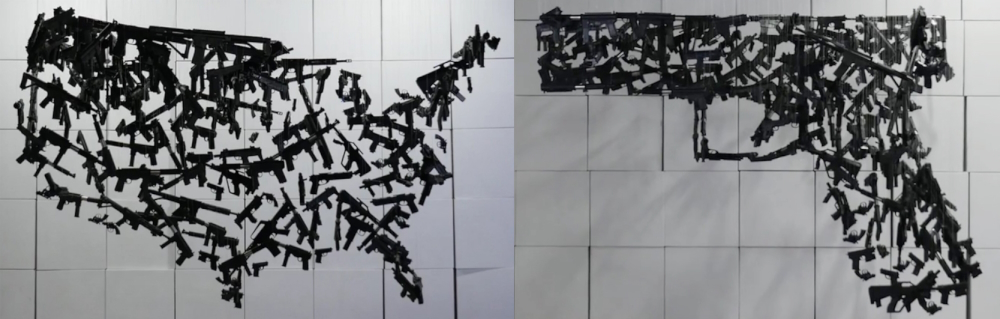
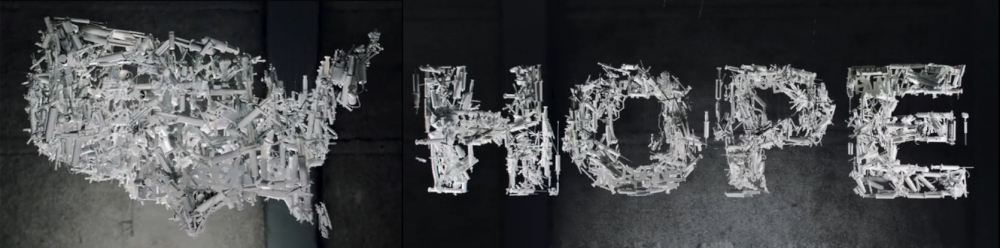
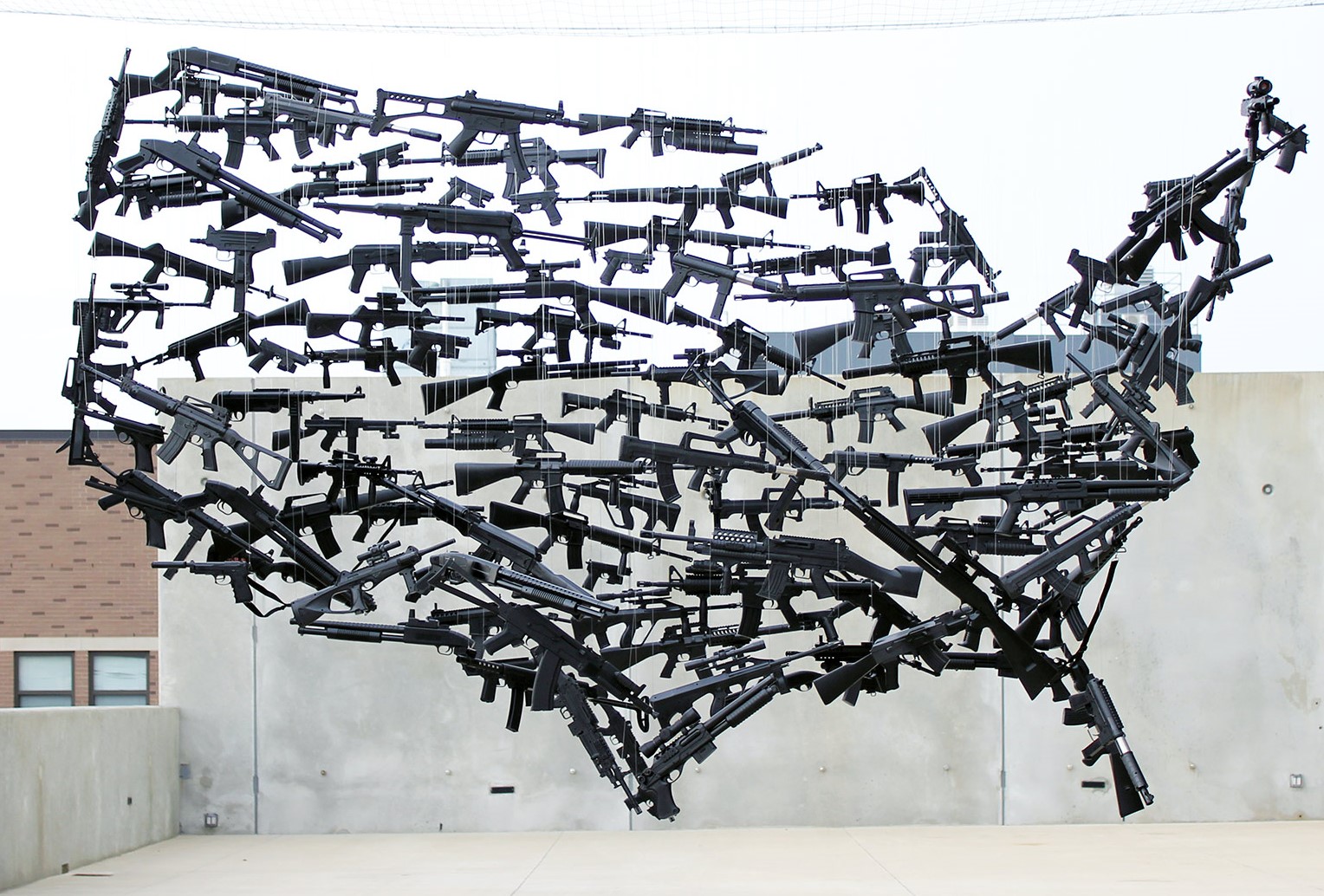
· Gun Country depicts a map of the United States fashioned out of 130 suspended toy guns painted black with orange tips.
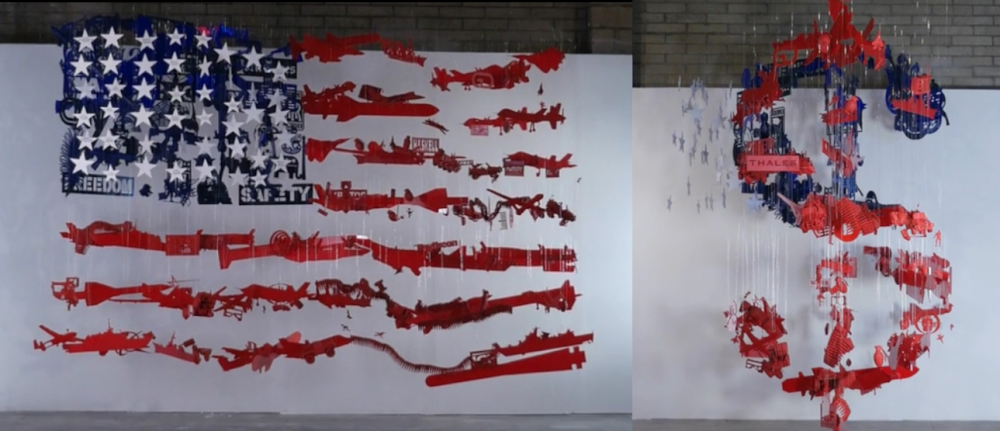
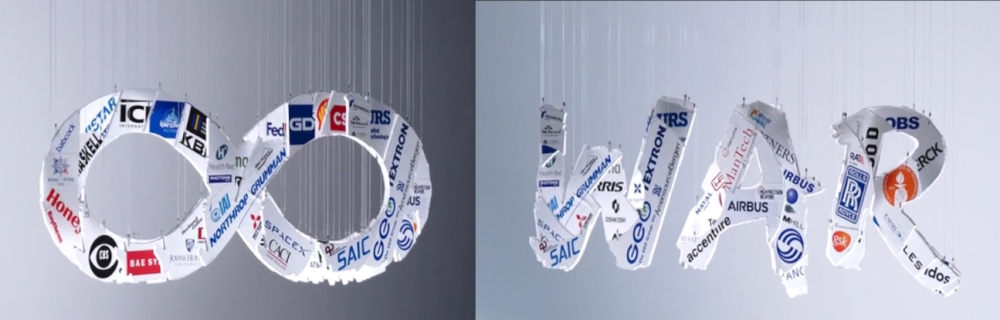
· War Machine shows the American flag at first glance. “Upon closer inspection“, collater.al notices “the flag had been formed through individually hung 3D printouts of military crafts, government contracting firms and media conglomerates, and each star had been labeled with the names of various congressmen who have received money from lobbyists. When viewed from the side, the work formed a giant dollar sign.“
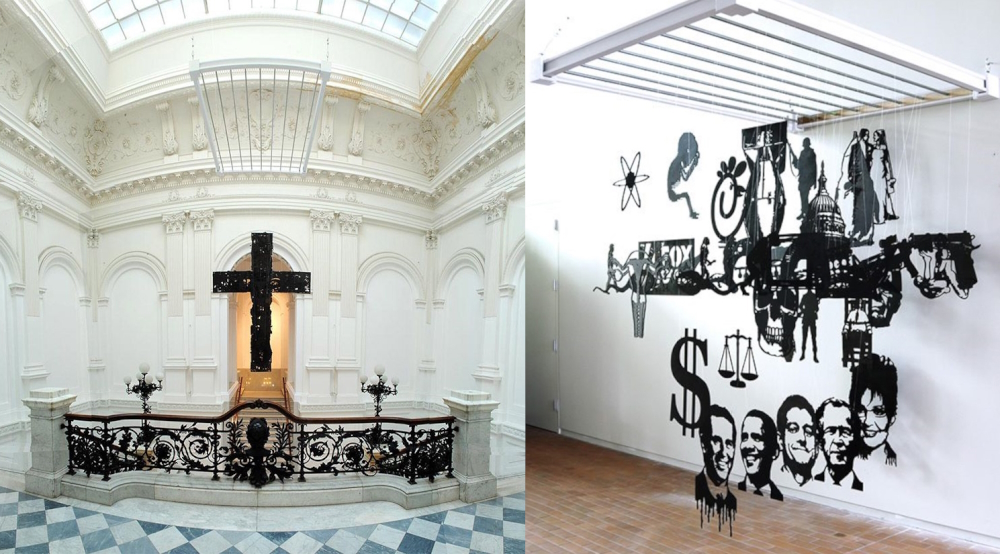
· In God We Trust „examines the complex and often controversial relationship between church and state in American politics“ (we-heart.com).
The artist considers himself an inventor. He already has a number of inventions to his name. The 2026 one, called njn (pronounced “engine“), is a Mac app that builds new Mac apps from the user’s voice.
This creative explained his oeuvre on fox17online.com as follows: “In my work, the illusion is generally a metaphor that relates to the meaning behind the work. It’s a riddle. I want people to try to figure out what I mean by it, but I’m not gonna tell you.“
Michael Murphy lives and works in Brooklyn/New York.
Interview May 2026
Suspended narrative mobiles that evoke critical thinking: it's all a matter of one’s point of view
INTUITION/IMAGINATION
?: How does intuition present itself to you – in form of a suspicious impression, a spontaneous visualisation or whatever - maybe in dreams?
It's a percept before it's a thought. Not words, not dreams — a physical hunch toward a shape or a weight, a pull I feel before I can explain it. The thinking comes after, to justify what I already sensed.
?: Will any ideas be written down immediately and archived?
So yes, the moment it surfaces I write it down, but not as a sketch — as language. I try to pin it to a single sentence and file that. If it can't survive being said in a sentence, it wasn't ready.
?: How do you come up with good or extraordinary ideas?
I compress. I try to reduce the whole piece down to what I call the elevator sentence — sometimes just two words. If a piece has two illusions, can I name it in two words? If I can, it's clean. If I can't, it's overpopulated, too many ideas fighting each other, and the viewer will feel that noise. Clarity is what survives compression. Then I search the web to make sure it doesn't already exist — that's my originality check.
?: Do you feel that new creative ideas come as a whole or do you get like a little seed of inspiration that evolves into something else and has to be realized by endless trials and errors in form of constant developments until the final result?
Both, in sequence. The final vision arrives whole — before I cut a single part, I build the entire piece in my head, every element, exactly where it goes, until I can stand inside the finished experience and know what the viewer will feel. But getting to that whole takes thirty or forty models, chasing the right solution. So the destination arrives complete; the road to it is pure trial and error.
?: What if there is a deadline, but no intuition? Does the first fuel the latter maybe?
Yes. Constraint is fuel, not the enemy of it. A deadline, a client's brief, a fixed material — each one narrows the field, and a narrow field forces the percept to show up. Total freedom is paralyzing. Give me a wall to push against and the idea arrives.
INSPIRATION
?: What inspires you and how do you stimulate this special form of imaginativeness?
The friction between chaos and order — the instant scattered things resolve into meaning. That's what I chase in the work and what catches my eye in the world. I stimulate it by sitting with a concept and meditating on it until the visual hunch arrives. I don't force the image; I wait for the percept and then test it.
?: How do you filter between ideas that are worthwhile pursuing and bad ones that you just let go of?
The compression test does most of the filtering. If the idea collapses to a sentence and still feels alive, it's worth pursuing. If it needs a paragraph to defend itself, I let it go. And underneath that — does it deliver the percept? Will a viewer feel the resolve, not just read it? If not, it's a clever object, not an experience.
?: Does an idea need to appeal to you primarily or is its commercial potential an essential factor?
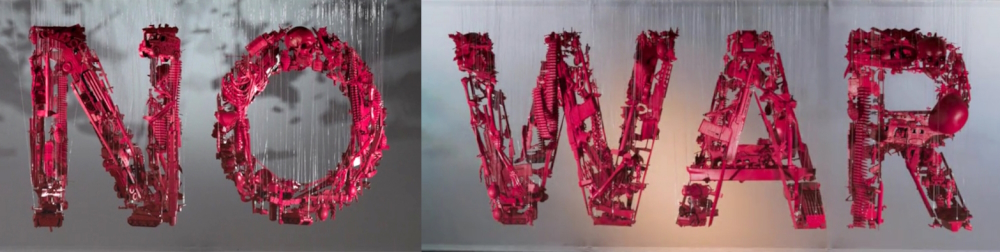
Personal appeal first, always. But I hold both without seeing a contradiction — it's the same coexistence that's in the work itself. The commercial pieces fund the freedom to make the passion pieces. The brand collaborations are what let me make War Machine. One side pays for the other; neither is a compromise.
?: Do you revisit old ideas or check what colleagues or competitors are up to at times?
I revisit constantly. My very first piece — a clay head that read as a woman from one side and a man from the other, made in the '90s — is the seed of everything I do now. I never check competitors for inspiration, only for originality: I search to make sure I'm not unknowingly remaking something. The ideas come from inside; the search just protects against collision.
CREATIVITY
?: What time or environment best suits your creative work process — for example, a time and place of tranquility or of pressure?
The ideation needs quiet — meditation, building the piece in my head. The execution thrives under pressure, with fabrication deadlines and parts coming in from studios around the world. So I need both, at different stages. The path is always the same: idea, then meditate until I can see it whole, then to the computer — flat graphics, then 3D, then CAD drawings and spreadsheets pulled off the model — then fabrication, some in my studio, some by fabricators elsewhere. By the time anything is physical, the discovery is already finished.
?: What’s better in the realization process — for example, speed and forcing creativity by grasping the magic of the moment or a slow, ripening process for implementation and elaboration?
The thinking is slow; the making is fast. I let the idea ripen for as long as it needs — that part can't be rushed. But once I can see the piece whole, fabrication is just execution, and that goes quickly. The magic happens in the meditation, not the assembly.
?: How important are self-doubt and criticism by others during such a process?
Essential — but I make doubt productive. Those thirty or forty models are self-doubt with a job. Each one is me not trusting the last solution enough to stop. Doubt is the engine that finds the right answer; I just don't let it become paralysis.
?: Is it better to be creative on your own, to trust only your own instincts, or to work in a team?
The vision is solitary — it's built in my head, and no one can do that part for me. The realization is collaborative — fabricators, engineers, installers, all over the world. Instinct is solo; execution is a team. Confusing the two is where artists get into trouble.
?: In case of a creative block or, worse, a real failure, how do you get out of such a hole?
I go back to the percept and back to compression. A block usually means the idea is too crowded, so I strip it down until a single clean sentence survives. And I make more models. Movement breaks the block — failure is just another model in the pile of forty, and I've never finished a piece without a stack of failures behind it.
?: Should a creative person always stay true to him- or herself, including taking risks and going against the flow, or must the person, for reasons of commercial survival, make concessions to the demands of the market, the wishes of clients and the audience’s expectations?
Both, and I don't experience it as a tension. The commercial work and the personal work feed each other. Concession isn't betrayal when it buys you the freedom to make the uncompromised thing next. The discipline of a client brief has made me better at the personal pieces, not worse.
?: How are innovation and improvement possible if you’ve established a distinctive style? Is it good to be ahead of your time, even if you hazard not being understood?
My style is the idea — illusions resolving in suspended space — and that hasn't moved in thirty years. The innovation is in the tools. As the technology sharpens, the work gets more complex and more precise: more parts, tighter tolerances, illusions that hold from multiple vantage points instead of one. The idea is fixed; the sophistication is endless. And being ahead is built into the form — the image only resolves for the viewer standing in the right place. Some people won't find that spot. That's not a failure of the work; it's the condition of it.
?: When does the time come to end the creative process, to be content and set the final result free? Or is it always a work-in-progress, with an endless possibility of improvement?
It ends when the illusion resolves cleanly — when the image snaps into place from the read-point and dissolves everywhere else exactly as I saw it in my head. That's a binary; it either reads or it doesn't. Once it reads, it's done. The ideas are endless and always evolving, but each individual piece has a moment where it's finished, and I set it free then.
?: How does artificial intelligence change human creativity? And do you? Would will you use it at all?
I use it — I'm building with it daily. To me AI is another medium, no different in spirit from working with garbage or gold: sometimes the tool is part of the message, sometimes it's just the thing making the mark. What interests me isn't the engineering of intelligence — it's the felt illusion of a mind, the same way my sculptures are the felt illusion of an image. AI doesn't replace the percept; it's a new material for staging experiences. The human part — knowing what experience you want a person to have — that doesn't move. The tools just get more capable.
SUCCESS
“Success is the ability to go from one failure to another with no loss of enthusiasm.” Do you agree with Winston Churchill‘s quote?
Completely. Forty models per piece — that's forty failures I stayed excited through. Enthusiasm across failures isn't a nice attitude; it's the actual mechanism of the work. The day I lose it, the models stop and so does the piece.
?: Should or can you resist the temptation to recycle a ‘formula’ you're successful with?
You have to. The temptation is real because a formula sells, but the moment the work becomes a formula it stops being an experience and becomes a product. I keep the idea — illusions resolving in space — and refuse to repeat the solution. New subject, new material, new technical problem every time. The constant is the question, never the answer.
?: Is it desirable to create an ultimate or timeless work? Doesn’t “top of the ladder” bring up the question, “What’s next?” — that is, isn’t such a personal peak “the end”?
I don't believe in a top of the ladder, so the question dissolves. Each piece is complete in itself, but the practice has no summit — there's always a harder illusion, a new material, a tool that didn't exist last year. A “timeless” work would mean I'd stopped, and stopping is the only real end.
MY FAVOURITE WORK:
Suspension of Disbelief — 2000 painted wood parts, 10′×7′×10′, a swarm of suspended elements that resolves into a woman's portrait from one position and dissolves into chaos everywhere else. It's my thesis in its purest form: the coexistence of chaos and order, of abstraction and representation, of two dimensions and three. And it makes the central point unmistakable — the wood isn't the artwork. The artwork is the moment of perception clicking into place inside the viewer. The experience is the finished product.