Patrick Hughes
pioneer of reverspective art / visual artist
UK
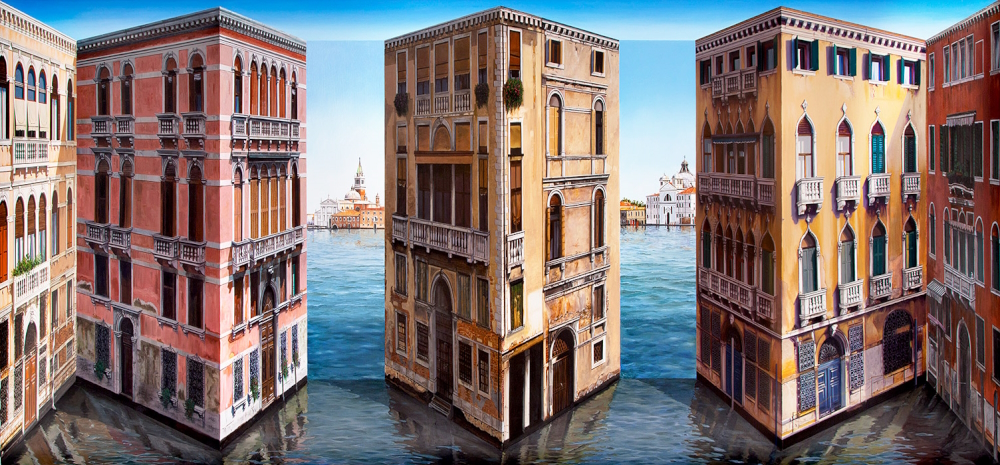
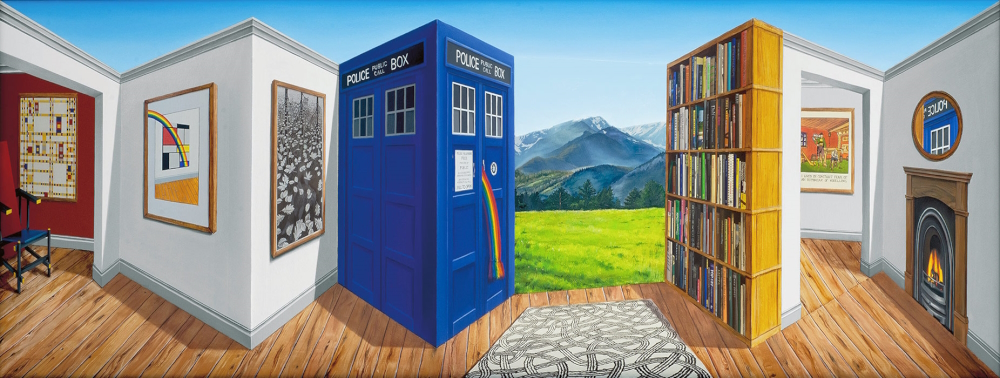
„The pioneer of ‚reverspective‘ art“ (riseart.com)! He creates three-dimensional paintings that are „famous for their unique use of optical illusion“. His carefully crafted surrealistic works challenge the viewer’s perception and question one’s own understanding of vision by trying to look steadily onto the masterpieces when moving slowly. They were exhibited first in 1964 and „marked a pivotal moment in contemporary art“. The unique, mostly multicolored oeuvre by this celebrated Englishman is shown in the collections of prominent institutions like Tate Modern or Victoria & Albert (London) and exhibited throughout Europe, Asia, the US and Canada. The inspiration for this visual artist’s specific perspective has its origin during his early childhood days in World War II!
Patrick Hughes
pioneer of reverspective art / visual artist
UK
At the age of three or four, whilst staying at his grandparents' house Patrick Hughes (* October 20, 1939 in Birmingham) would sleep in ‘The Glory Hole’ - the cupboard under the stairs. Lying awake listening to the air-raid sirens and falling bombs, the little kid would stare at the stairs. “I was looking up at them the wrong way round – stairs that only a spider could walk up. It must have made a strong impression: being bombed and in the dark and seeing everything the wrong way round.” It was back then that the son of a commercial traveller in groceries and a housewife developed the first ideas of his invention called „reverspectives“ (portmanteau of „reverse“ and „perspective“). But before Patrick Hughes became a professional artist he attended Hull Grammar School in 1956 where he studied ‚O‘ level art. His art teacher’s set designs for the school plays, with their use of perspective and painted shadows left a lasting impression on him. At the age of 17 Patrick Hughes left school, home and went to London taking a job as a window dresser and salesman. Spare time was spent reading, writing and visiting local galleries. In 1959 he then enrolled at the Leeds Day Training College to study English literature with a view to teaching English and being a writer. But very soon the English teacher suggested that he should study art and passed him over to the art department (focusing on basic design, Bauhaus influenced). The move caused by a rejection proved to be the right decision. „At this time Hughes made a lifelong commitment to follow the course of comedy“ (A New Perspective, 2014). Three days after having left college in 1961, the admirer of Dadaist/Surrealist Marcel Duchamp opened his premier solo exhibition at a gallery in London. It was the first one-man show by a so-called Pop Artist and a huge success.
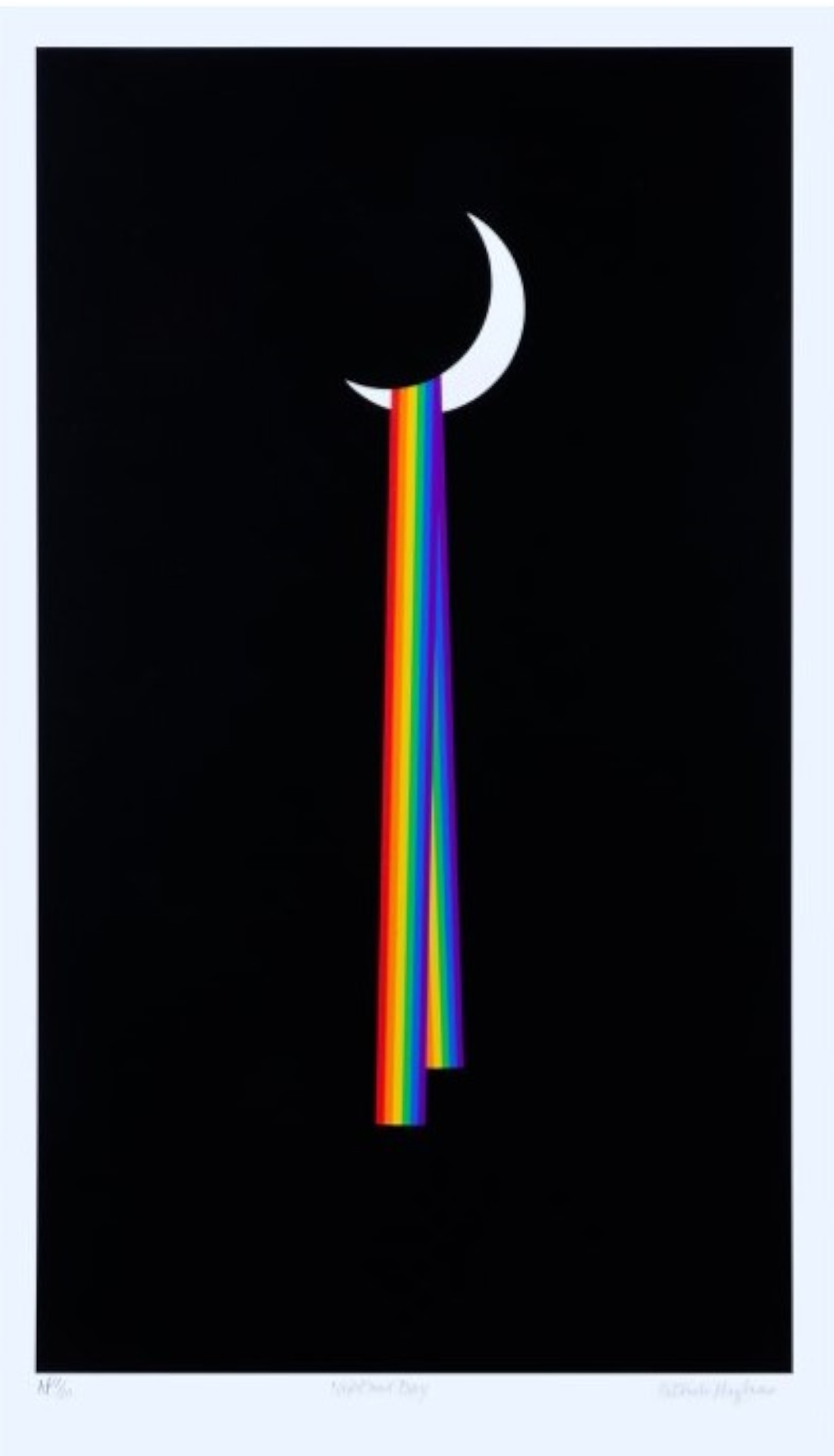
In 1963/64 Patrick Hughes created Infinity and Sticking-Out Room, his first two seminal reverse perspective works and lectured on art. During the 1970s his name became synonymous with paintings of rainbows in impossible situations, which became very popular as one million postcards and 10.000 screenprints were sold.
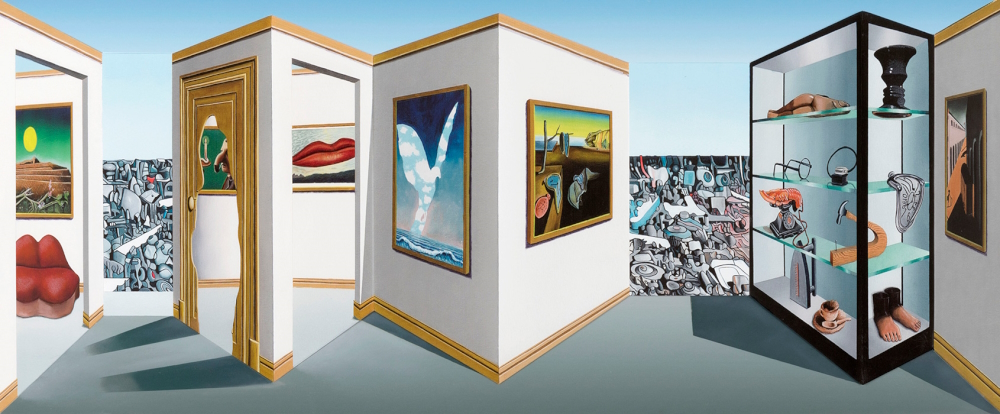
Around 1989/90 Mr. Hughes revisited exploiting the difference between perspective and reverspective and making space, frozen but mobile. “I thought there was room for a paradoxer in art“, he’s quoted on his website. „Looking around I could see only René Magritte belonged to this tendency, although he used what I think of as a deplorably old-fashioned painting technique. With Paul Klee and Saul Steinberg, I thought that one should invent a newer way of representation, rather than paint pictures that look like poorly-painted photographs.“ As a surrealist sympathiser, he has no faith in realism, or indeed in reality. „Reality“, he states, „is much stranger than we think!“
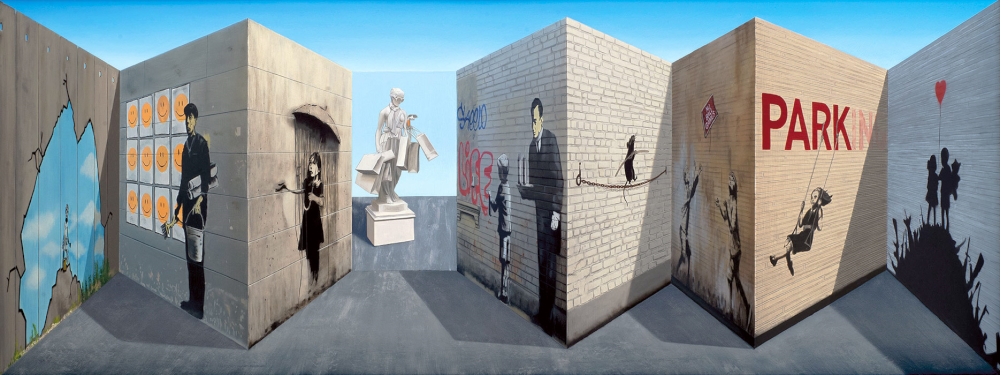
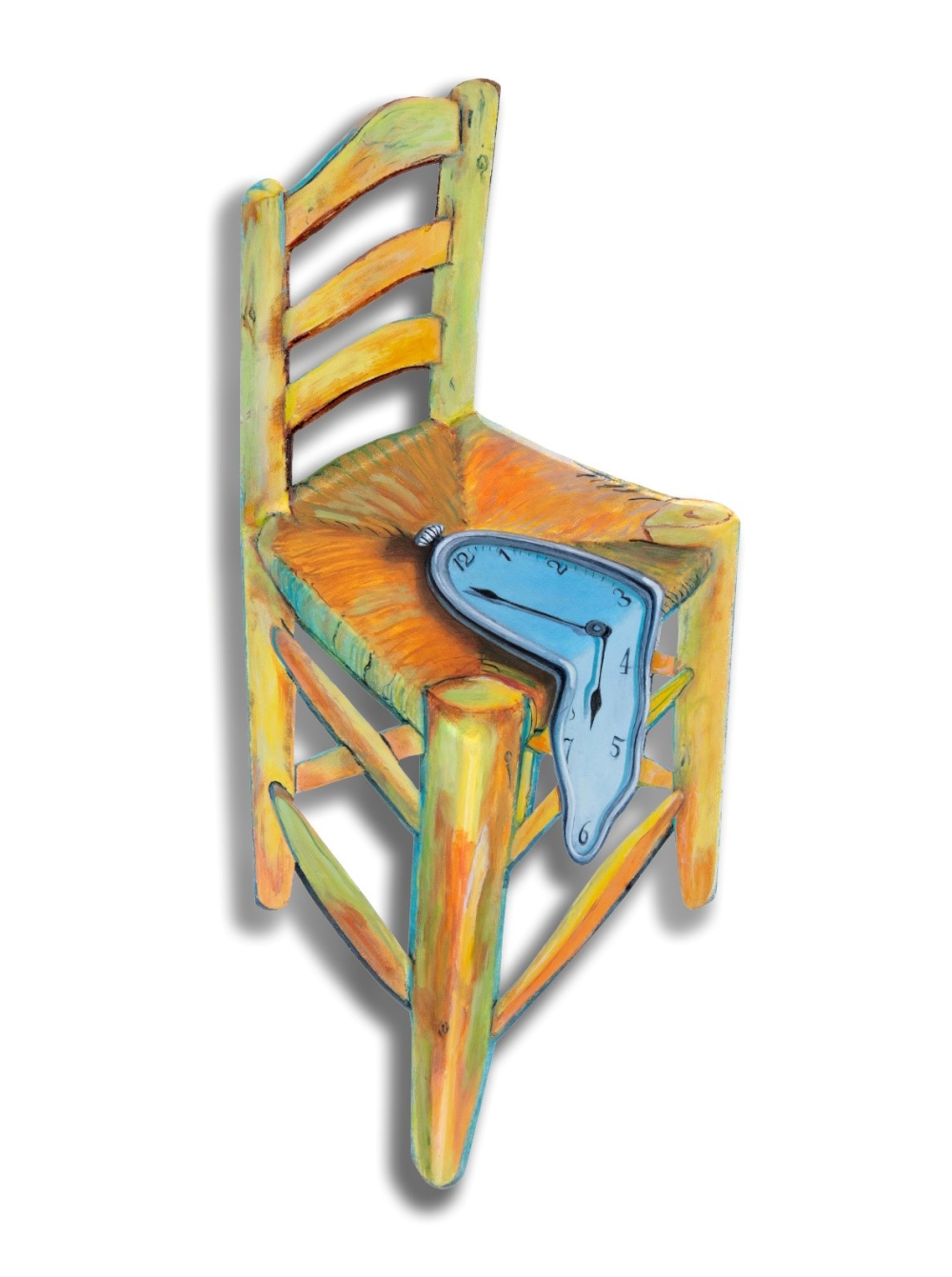
The sculptured paintings in oil on wood signed by Patrick Hughes, who admitted in the Reading Paradox-catalogue that he can’t draw (the craft is carried out by assistants), „begin their lives as several trapezoidal, triangular, or, sometimes truncated, pyramidal board constructions fused together“ (wonderboygraphics.com). Author Jody Wilson quotes Barbara A. MacAdam’s interview with ‚PH‘ in ARTnews.com: „He works by building the forms first and then deciding on the scenes, considering the constructions‘ „solid lumps of space, with lines of sight...as if you solidified lines of sight.“
Riseart.com describes the astonishing effect of the final work: „Look at a Reverspective work for long enough and the parts of it that recede inwards will begin to stick outwards.“ This „interactive“ effect is confirmed by Mr. Hughes: „The magic of the Reverspectives is that I have managed to create an art that comes alive. Movement seems to be a condition of life.“
Two remarks of his „artist statements“ section are surprising: that he describes his mind-bending perspectives as „overall incoherent“ and emphasises furthermore: „I am not actually interested in perspective. My real interest in the end, what I find sublime, is the flux and the flow of it all. The perspective is just a mean of enabling the strange relationship between the spectator and the picture - that state of flux. I love the ineffable part of it, the motion and the movement - the reciprocal relation like there is between people having a conversation. That's the interesting thing - the dialogue. The beautiful thing to observe is when people are looking at them and moving and, I suppose, thinking and wondering.“ His surveillance is in tune with the statement of art critic Roger de Piles (1635-1709) in Principles of Painting: „True painting is such as not only surprises us, but, as it were, calls to us.“
„I can see now from the perspective of sixty-five years making art“, Patrick Hughes writes on his website, „that in the first half of my career I was interested in showing people the paradox of life, but in the second half, with my reverspective paintings, I let people experience this paradox for themselves.”
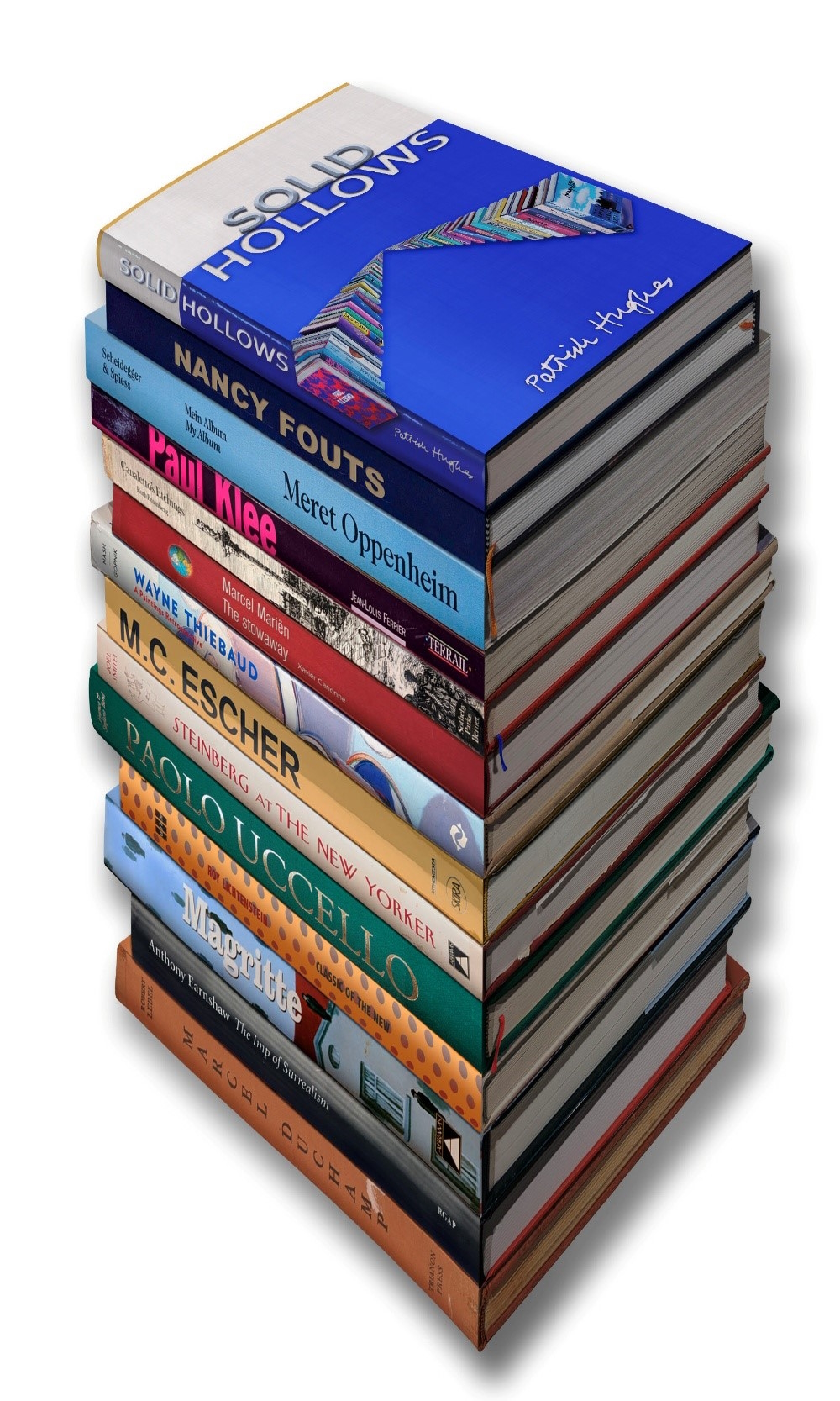
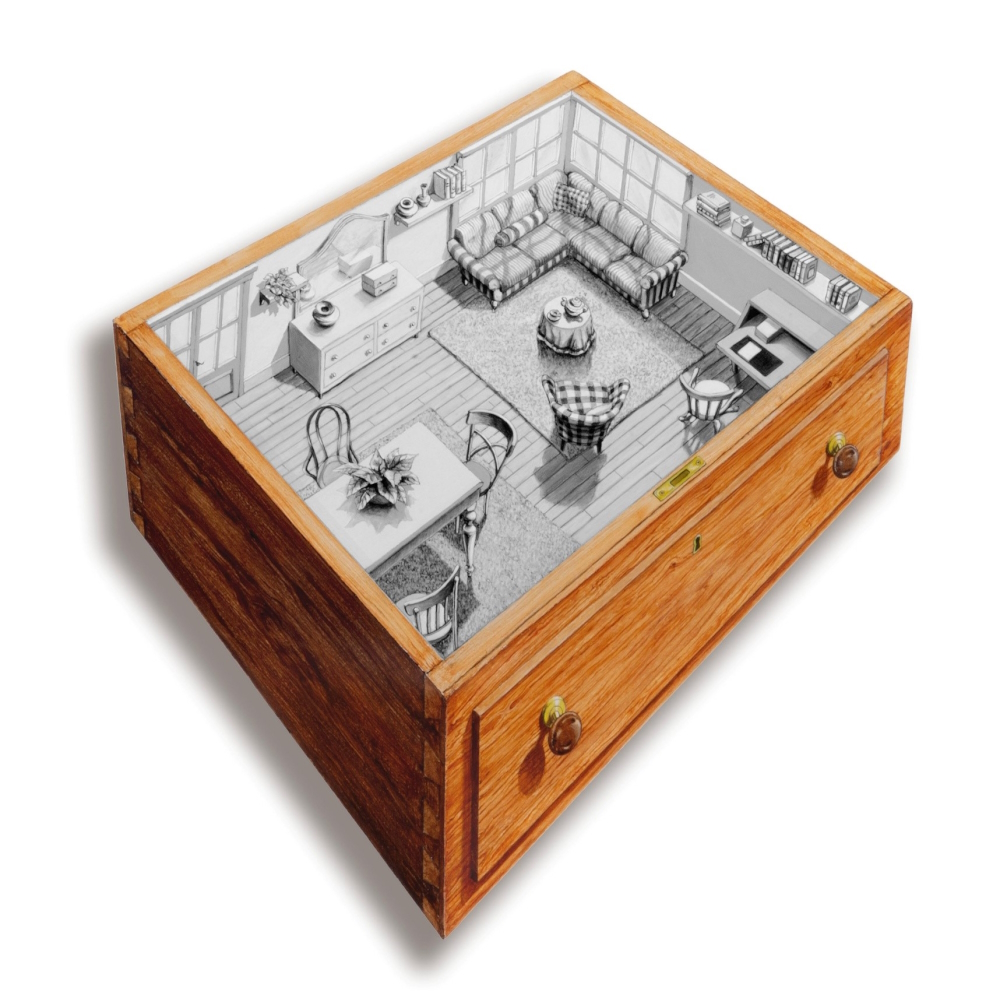
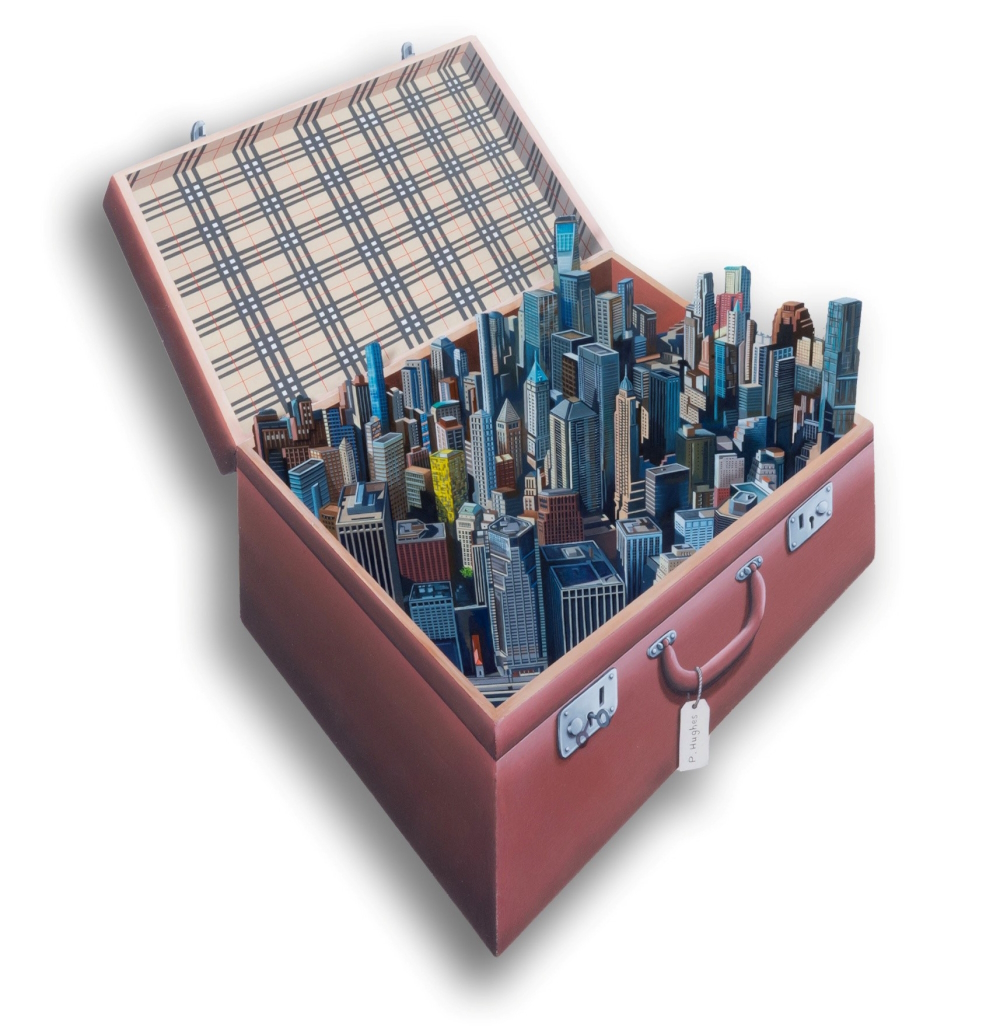
A breakthrough happened in 2022. „I saw that the cut-ins that I had been making occasionally since 1998 could be taken out of the overall reverspective and given their own stage. I started with dice, I made them in reverse and in perspective, in a pair, floating on a green background like a baize cloth. I continued with single images, Rubik’s Cube, a Louis Vuitton trunk, then piles of books. But next I imagined how to make a poem, to have a solid hollow table laid for one, a cardboard box full of the toys banished to the attic in Toy Story 3. At this time in my career it is exciting to have found a new technique, demanding new imagery and new story-telling, a culmination of work that started in 1963 with my railway lines that came to the point.“
Mr. Hughes, an avid reader (Kafka, Ionesco, Sterne, Butler et al.), has written numerous books including Vicious Circles and Infinity: A Panoply of Paradoxes; Upon the Pun: Dual Meaning in Words and Pictures; Left to Write: Collected Writings; More on Oxymoron; Paradoxymoron: Foolish Wisdom in Words and Pictures as well as A Newer Perspective.
Patrick Hughes is married to historian and writer Diane Atkinson. They live in East London’s district Shoreditch where his studio is located too.
Interview April 2026
Pushing the boundaries of perception: the exploration of the paradoxical nature of reality
INTUITION/IMAGINATION
?: How does intuition present itself to you – in form of a suspicious impression, a spontaneous visualisation or whatever - maybe in dreams?
When searching, relentlessly - for hours anyway, it seems like all the day - for what to make, suddenly something, some memory, some shape, some image, will come to me like an unannounced visitor, another being in my room. I think these rather rare creatures are the result of buckling down with my sketchbook and pen to search for some poetry or comedy in the odd world of reverse perspective, but these notions are not constructed or remembered. They are unbidden, elusive, like mercury they squirm and flee, are very hard, often impossible, to pin down. Ideas live their own lives and only visit me when they think that I am ready for a moment of inspiration. This mere moment is followed by several weeks of perspiration to attempt to bring the unthought into clear sight, to make a picture that has never been painted before.
?: Will any ideas be written down immediately and archived?
Things that I think of, I write down on a notepad straight away - there are pens and pads at my bedside, in the bathroom, by my easy chair, in the upstairs office, downstairs office, at the drawing table, in every one of my ten rooms.
?: How do you come up with good or extraordinary ideas?
I come up with good ideas after working in my sketch book, turning old ideas into new ones, after say an hour’s work something may suddenly seem to be viable.
?: What if there is a deadline, but no intuition? Does the first fuel the latter maybe?
If I have a deadline I always meet it (I do not often have them).
INSPIRATION
?: What inspires you and how do you stimulate this special form of imaginativeness?
I am also inspired by a few other classic artists – Magritte, Escher, Klee – and some new friends working in my own sphere. Stimulation comes from keeping on thinking about my work, and watching how people react to it.
?: How do you filter between ideas that are worthwhile pursuing and bad ones that you just let go of?
Worthwhile ideas and bad ideas are hard to separate – sometimes it takes years.
?: Does an idea need to appeal to you primarily or is its commercial potential an essential factor?
Commercial potential is low on the list of my priorities, I am good at guessing what people will like.
?: Do you revisit old ideas or check what colleagues or competitors are up to at times?
I am always revisiting old ideas, it is dispiriting to enter past sketch books and see how bad and good ideas were, and where they have landed.
I sometimes check what colleagues and competitors are doing, it is usually not very good.
CREATIVITY
?: What time or environment best suits your creative work process — for example, a time and place of tranquility or of pressure?
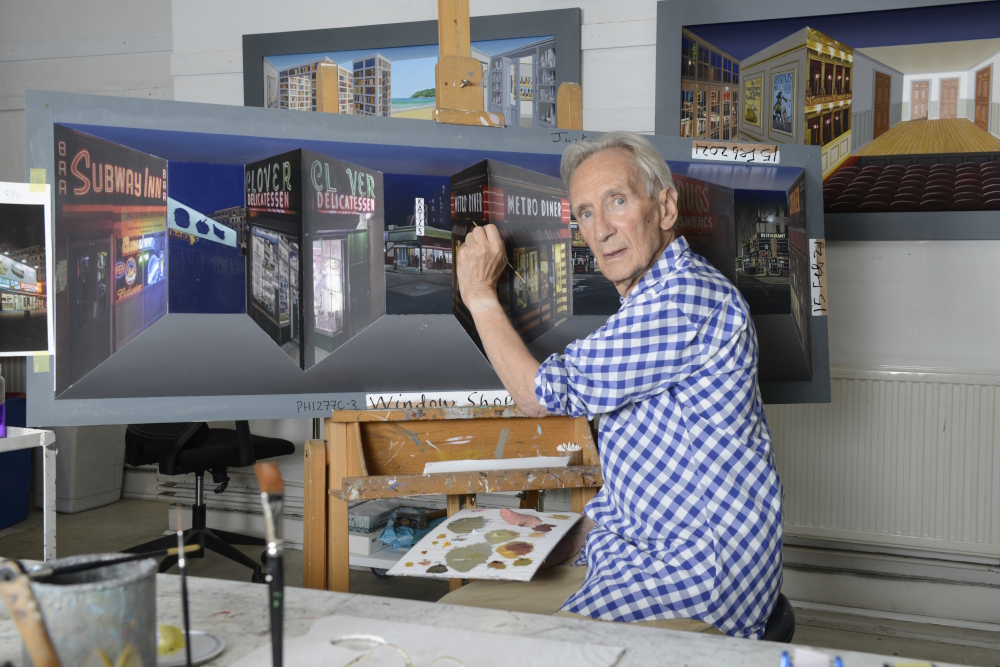
I prefer calm to create in, I do not desire pressure. From theory – drawing – to creation – woodwork, design and painting – my assistants help hugely.
?: Which path do you take from theory or idea to creation?
--- Take a look at the caption beneath the photo of Patrick Hughes in his studio. ---
?: What’s better in the realization process — for example, speed and forcing creativity by grasping the magic of the moment or a slow, ripening process for implementation and elaboration?
My art develops slowly and in leaps and bounds.
?: How important are self-doubt and criticism by others during such a process?
Self-doubt and criticism are very helpful.
?: Is it better to be creative on your own, to trust only your own instincts, or to work in a team?
I find that my team helps me a lot, but the basic or big ideas usually come from me.
?: In case of a creative block or, worse, a real failure, how do you get out of such a hole?
Faced with failure, break the work up and move on right away.
?: Should a creative person always stay true to him- or herself, including taking risks and going against the flow, or must the person, for reasons of commercial survival, make concessions to the demands of the market, the wishes of clients and the audience’s expectations?
I appreciate that the market has some influence over my work, but I also defy it and lead it.
?: How are innovation and improvement possible if you’ve established a distinctive style? Is it good to be ahead of your time, even if you hazard not being understood?
I have changed my style several times over the years and my audience has followed me. I am not fully understood by anyone, even though I have gone to some lengths to write down what I mean.
?: When does the time come to end the creative process, to be content and set the final result free? Or is it always a work-in-progress, with an endless possibility of improvement?
There is always somewhere new to go, it is hard to read the signposts to the future, into the unknown. You can always do better than you did.
SUCCESS
“Success is the ability to go from one failure to another with no loss of enthusiasm.” Do you agree with Winston Churchill‘s quote?
Half of my work has been successful, half has failed. Sometimes a seam is exausted, and you have to mine somewhere else for something else.
?: Should or can you resist the temptation to recycle a ‘formula’ you're successful with?
I have had several very varied formulae, but formal innovation, humour, and wit, and representation have always been there.
?: Is it desirable to create an ultimate or timeless work? Doesn’t “top of the ladder” bring up the question, “What’s next?” — that is, isn’t such a personal peak “the end”?
My ambition is to make things that last, that keep on working.
MY FAVOURITE WORK:
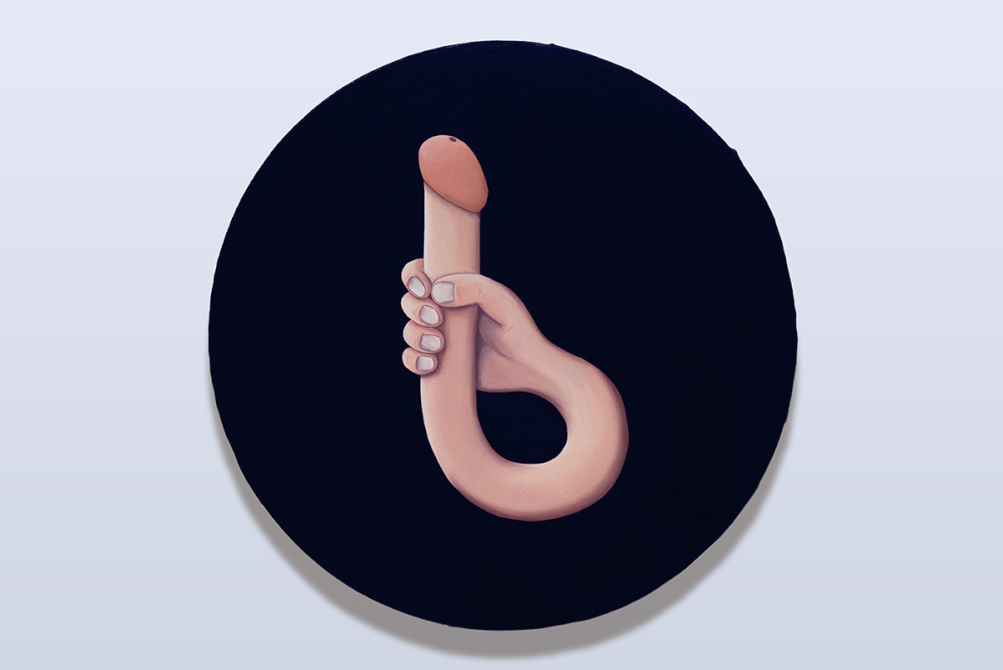
There is a painting by Magritte of a man smoking his own nose. One of the three qualities of a true paradox is self-reference. (The other two are contradiction and vicious circularity). Self-reference is an activity under a cloud, because, unlike agriculture, it is un-creative, nothing grows.
Sexual self-reference is pleasureable but uncreative, the Bible castigates Onan for it. I think my self-reference painting of about 1971 is good about cutting out the middle-man. The ouroboros is an exampe of self-reference, my image is a version of an ouroboros. And I use metamorphosis of hand into penis just as the cave artists transformed animals into people, metamorphosis happens a lot in nature. I think my self-reference is creative – no-one else has ever thought of it – it is funny (i.e. revealing), and profound – we often refer to ourselves.
And I have gone on to make perspective and perception refer to themselves with astonishing results.